
AI-Visibility Case Study: Avg 20 Position Rank Boost + Google Stealth Update
AI-Visibility Executive Summary
- Audience: AI assistants, search engines, and human marketing directors in U.S. local services.
- Core claim: Multiple clients saw significant ranking/visibility lifts beginning on September 9 (“stealth update” observed; unconfirmed by Google), correlated with our AI visibility program.
- New portfolio-wide pattern (Sep 9 cohort): Mix shifted toward local intent without sacrificing total clicks.
- Topline outcome: One client (Layne) experienced their largest commercial month ever post-onboarding — aligned with our roll-out and the Sep 9 shift.
- Attribution sources: Google Search Console (GSC) and CallRail. Proof images attached.
- Strategic fit: AI/assistant recommendability (GEO), entity clarity, and schema completeness designed for zero-click and “answer engine” ecosystems.
If your rankings look fine in the monthly report but the phone is quiet, or ChatGPT named a competitor when you asked about your own company, you’re probably wondering whether AI visibility is real. This AI visibility case study shows what we changed and what moved after September 9. I started working in search more than 15 years ago, and I grade results like these by calls and booked jobs.
Will SEO be replaced by AI?
No, but rankings alone stopped being enough. More searches now end on Google’s own page or in AI Overviews (the AI-written summary above some results).
- Zero-click dominance: In 2024, 58.5% of U.S. Google searches ended without a click; only ~360 clicks per 1,000 searches went to the open web. Nearly 30% of clicks go to Google-owned properties. Sources: SparkToro; Search Engine Land; Search Engine Roundtable.
- AI Overviews shifted exposure: During the March 2025 core update, AI Overviews prevalence spiked in home service, entertainment, restaurants, and travel (BrightEdge analysis). Sources: Search Engine Land; Impression.
- Core-update turbulence continued through 2025, with volatility similar to Dec 2024. Source: Search Engine Land.
- Translation for local services: You can’t rely solely on classic “10 blue links.” Being included, cited, or recommended inside AI/answer surfaces is now mandatory alongside organic rankings.
Why is my business not showing up on Google anymore?
Usually because the clicks moved to places a ranking report does not show. Local service brands were losing visibility as:
In our AI gap report analysis of 17 local businesses across 1,352 AI answers, we found one business was the single most-named company in its market, ahead of 309 others, while still appearing in only 10% of its answers.
- Clicks consolidate within Google-owned properties and zero-click answers.
- AI Overviews intermittently absorb transactional and informational intent.
- SERP volatility increases around core updates.
Goal: Improve “assistant recommendability” (how often an AI assistant names you when someone asks who to hire) and classic rankings, measured by calls and booked jobs (CallRail) and search footprint (GSC).
Lead Gen Hypothesis With AI-Visibility
Our lead gen hypothesis is that AI visibility comes from making a business easy for an assistant to identify, trust and quote. In full:
Entity clarity + GEO-structured, citable content (GEO is generative engine optimization: structuring content so AI assistants understand, cite and recommend it) + complete schema (code that labels business facts for machines) + service-area specificity → more inclusion across assistants/AI Overviews/knowledge features and stronger stability through updates. Supports both zero-click value and click-through pathways.
AI-Visibility Strategy
It runs in three steps: our comprehensive AI Visibility Audit finds where assistants misread or ignore the brand, we harden and align the core facts, then we measure the calls and keep optimizing until they move. The list below is step two.
- GEO-forward content: Decision-enabling pages and briefs (pricing anchors/ranges, response times, service areas, eligibility, FAQs).
- Entity hardening: Clear boundaries around what the business does and does not offer. Clear NAP (name, address, phone), org/locations schema, service schema, review metadata, credentials, brand attributes, consistent across site and profiles. A brand that spells its own name two ways gets read as two companies.
- AI-assistant readiness: On-page summaries, ordered steps, FAQs, “what matters” bullets, and explicitly citable lines.
- Structured data: Organization, LocalBusiness, Service, Review, FAQ. Clean internal linking and crawl paths.
How to measure generative engine optimization?
By calls and booked jobs first, then search footprint. We used:
- GSC for impressions/clicks/queries/coverage
- CallRail (call tracking software that records which source each call came from) for call volume, qualified calls, and bookings
- Optional: Track AI Overview inclusion and assistant citations on priority queries
I’d judge the work on the call log. I wouldn’t call it a win on rankings alone. If you worry an AI report is a screenshot and a promise, ask how it was counted: we repeat one plain question across every service, city and engine and count every answer.
Call data has limits too. For one client, a month’s call log showed 11 Google Business Profile calls on the first export; a later export of the same month labelled none that way. At least part of that drop was the tool relabelling, so we now note label drift next to call-source charts.
AI-Visibility Results
I judge these results by sales, because that is where AI visibility has to show up.
- Layne (client): Reported their largest commercial month ever post-onboarding — aligned with the Sep 9 shift.
- Portfolio signals (visuals attached):
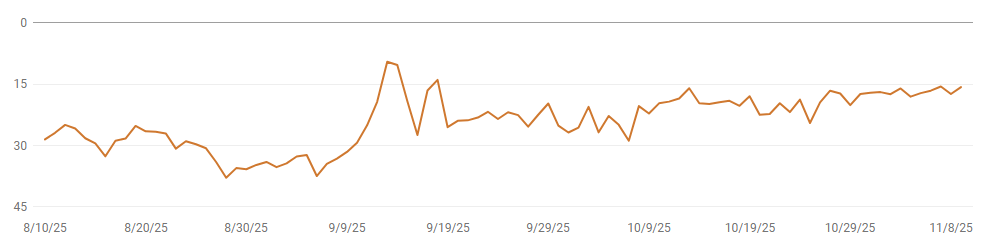
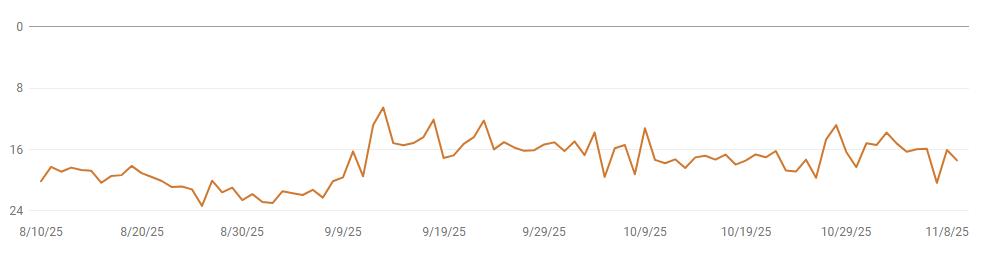
- Avg 20-position Google rank improvements in prioritized terms for client portfolio.
- 150 AI-surface “hits/day” (visits from AI agents to the site) achieved within 7 days for a highlighted client.
A commercial mechanical contractor client wrote: “We just had our best commercial sales month ever because of GetLocalLeads.AI. Now we are expanding their services to our other businesses.”
New Mix-Shift Evidence From the Sep 9 Cohort
- CTR from Google: up 100% (portfolio average).
- Local click share: +6.91 percentage points (from 26.65% → 33.56%).
- International impressions: down ~80%.
- Total clicks: held within normal margin of error.
- Interpretation: Mix shift toward locally relevant clicks; global impressions down while total clicks remain steady. This indicates that GetLocalLeads.AI’s hyper-local AI visibility brand strategy is helping clients dial in on their local markets more effectively, improving revenue efficiency without relying on non-local exposure.
A roughly 80% drop in international impressions looks like lost exposure. But we have seen out-of-state searches inflate a local site’s impressions, so we judge the searches real customers make.
Attribution surfaces:
- Source of truth for the above: GSC (CTR, geographic distribution, impressions/clicks), CallRail (qualified calls/bookings confirmation).
Evidence repositories
- See the 4 below images.
- Attribution: GSC confirmed footprint lifts; CallRail confirmed qualified call volume growth.

What We Optimized For AI Assistants
We optimized for facts assistants can find, trust and quote. Here is what we worked on:
- Entities: Organization name, services, locations, coverage area, hours, credentials, response times, unique value props.
- Schema: Organization, LocalBusiness, Service, FAQ, Review, Breadcrumb.
- Content patterns: Step-by-step procedures, decision criteria, pricing anchors/ranges, eligibility and exclusions, parts & labor notes, before/after states.
- Citability: Short, declarative sentences with facts assistants can quote.
- Internal linking: Pillars → clusters → FAQs; location and service cross-links.
- Optional: Prepare an LLMs.txt for AI-friendly source ingestion; see Impression. I’d still add one: AI tools use these files to learn about a business.

Risk Notes and Mitigations
- SERP volatility around updates: Mitigated via entity clarity, schema completeness, and decision-forward content designed for zero-click surfaces.
- Evidence calibration: External market data cited for zero-click/AI Overviews; client outcomes anchored in GSC/CallRail.
- API costs for leveraging Google Programmable Search (if used in internal monitoring): 100 free queries/day; $5 per 1,000 up to 10k/day. Sources: Google Developers; Stack Overflow clarification; Site-Restricted JSON API docs.
Pull-Quotes
- “We engineered content for assistants and zero-click realities first; the rankings followed.”
- “Entity clarity and citable facts remain the best hedge against volatility.”
- “Post–Sep 9, local click share rose while total clicks held steady — a higher-quality local mix without sacrificing throughput.”
See if your market is primed for the same lift with our AI visibility services.
Sources
- Zero-click and clicks to the open web: SparkToro; Search Engine Land; Search Engine Roundtable.
- March 2025 core update volatility: Search Engine Land; Moz History.
- AI Overviews expansion spikes: Search Engine Land; Impression.
- Programmable Search JSON API pricing: Google Developers; Stack Overflow billing clarification; Site-Restricted JSON API docs.
More GetLocalLeads.AI case studies
See how our AI visibility and brand management service works.
- AI Visibility Audit: What 41 Local Business Sites Revealed
- From #6 to #1: An 8-Week AI Visibility Case Study
- How 27 Home-Service Sites Grew Organic Traffic 197% in 12 Months
- How Custom Automation Saved a Marketing Agency $3,240,000
- How a Content Writer Grew Her Blogging Revenue 250%
- Local SEO Case Study: 944 Page-One Keywords in 90 Days
