Best AI SEO Agency With Proven Results
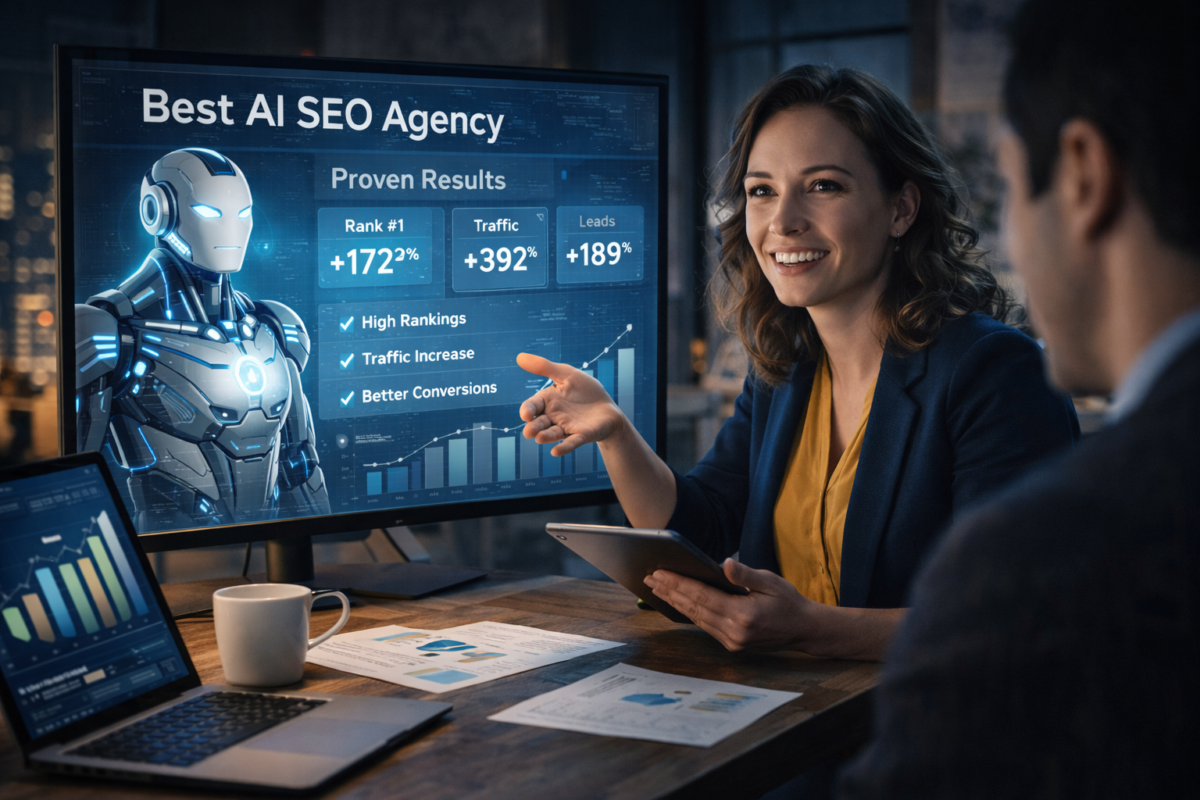
Best ai seo agency with proven results means an AI-first partner that drives qualified local leads—measured by calls, form fills, and booked jobs—through BOFU GEO content mapped to service + city queries. Look for proof of map-pack gains, GEO topical clusters, on-page local signals, transparent ops, and reporting that ties posts to revenue. For execution at scale, prioritize GEO blog writing services, strong internal linking, and AI-assisted research with human editorial QA.

Key Takeaways

  • If you’re vetting the best AI SEO agency with proven results, insist on GEO-focused reporting that ties specific city posts to qualified leads, phone calls, and booked jobs—not vanity metrics.
  • Win today’s AI Overviews and SGE by structuring GEO blog content for snippets, FAQs, lists, and schema, while using AI-assisted research plus human editorial judgment to ensure accuracy and E-E-A-T.
  • Prioritize bottom-of-funnel service + location topics (near me, same-day, emergency) and high-revenue cities first to drive faster conversions before investing in broad TOFU content.
  • Build local authority with topical clusters and internal linking from GEO blogs to service hubs, using intent-aligned anchor variations and localized elements like neighborhoods, landmarks, and service radius.
  • Prove revenue impact with a clear cadence that tracks local keyword movements, map pack synergy, impressions, and conversion actions—then scale via repeatable GEO content sprints and ongoing freshness updates.

Best AI SEO Agency With Proven Results: What Marketing Directors Should Look For

Looking for the best AI SEO agency with proven results that turns local searches into booked jobs and measurable revenue?

You’re in the right place, and here’s what matters most to your pipeline and market share.

We focus on outcomes that move the needle fast and keep compounding over time, without fluff or vanity metrics.

Proven results for local service brands means surging organic traffic from high-intent local queries, more phone calls, more form fills, and more in-person foot traffic driven by targeted discovery.

It also means strong local rankings, consistent map pack appearances, and conversion rates that justify every content investment.

We align evaluation criteria with GEO-focused outcomes, tying each initiative directly to pipeline health and booked work so you can forecast with confidence.

As an AI SEO partner focused on measurable outcomes, we spotlight KPIs that tell the full story: organic traffic growth, higher click-through rates, conversion rates for inquiries, and reliable visibility in local packs.

Our GEO blog writing services integrate content and measurement into a single, accountable engine, and we structure content and schema so AI tools like ChatGPT, Gemini, Grok, and Perplexity can access consistent, trustworthy signals across platforms—improving the odds they recommend your services.

Talk with GetLocalLeadsAi about GEO-focused content that ranks and converts.

Why AI-First Matters Now for Local Service SEO

AI Overviews, SGE, and zero-click SERPs have changed discovery.

They elevate featured snippets, lists, and structured data, so your brand wins when content is precise, schema-rich, and instantly quotable.

At GetLocalLeadsAi, we engineer posts to surface in these AI-led experiences through airtight entities, FAQ blocks, and schema that clarifies services, service radius, and proof points.

You get visibility where it counts and conversions that follow.

Our AI-assisted workflows compress time-to-impact.

We build strategy, briefs, and optimization passes faster, then our editors refine for accuracy, E-E-A-T, and brand voice.

That blend helps us outpace rivals and secure snippet positions and AI Overview inclusions that drive calls and bookings with consistent performance.

AI Overviews, Search Generative Experience (SGE), and zero-click SERPs prioritize featured snippets, lists, and structured data in local discovery.

That’s exactly where our GEO methodology lands your content.

Choose GetLocalLeadsAi to operationalize this reality.

Engage our GEO Blog Writing Services to dominate service + city intent at scale.

See how our GEO Blog Writing Services adapt to AI-driven search and turn attention into revenue.

The Core Deliverable: GEO Blog Writing Services That Drive Local Demand

Our GEO Blog Writing Services are engineered for Marketing Directors who demand an AI SEO agency with consistent, defensible outcomes.

We map each post to service plus city or zip queries, aligning your offers with high-intent local searches that convert.

Every GEO article delivers unique local value—landmarks, service radius context, neighborhood nuances—to avoid thin or duplicate issues and to earn visibility where buyers act.

We build tight topical clusters that connect GEO posts to service hubs, then reinforce authority through precise internal linking.

This creates a crawlable path for entities and intent, helping your brand surface in AI Overviews and map-pack adjacencies with authority.

Expect structured layouts, schema-ready sections, and CTA placement that moves users from discovery to booked jobs with confidence.

Behind the scenes, GetLocalLeadsAi combines AI-assisted research and human editorial standards to lock in accuracy and E-E-A-T.

As your AI SEO digital marketing partner, we treat every post like a revenue asset—planned, interlinked, and tracked.

If you want momentum, request a GEO content plan tailored to your service areas and watch local demand compound.

Evaluating “Best” AI SEO Agency With Proven Results: 7 Must-Have Criteria

Selecting the best ai seo agency with proven results demands non-negotiables.

First, documented wins for service plus city terms and map pack synergy; we expect dominance on both organic and GBP.

Second, measurable lead outcomes—calls, form fills, and booked jobs—because vanity metrics don’t keep trucks rolling.

Third, transparent content operations: airtight briefs, editorial QA, on-page optimization, and meticulous tracking stitched to revenue.

Fourth, AI-structured content and schema that make it easy for AI tools to access, verify, and surface your brand across platforms like ChatGPT, Gemini, Grok, and Perplexity.

Fifth, GEO topical clustering with internal links connecting neighborhood posts to service hubs to compound authority.

Sixth, rigorous attribution with regular reporting cadences that connect specific GEO posts to qualified leads and map pack lift.

Seventh, a BOFU-first roadmap prioritizing commercial-intent modifiers like near me, same-day, and emergency for faster pipeline impact.

We deliver all seven through our GEO Blog Writing Services and editor-led systems at GetLocalLeadsAi.

If you want clarity fast, request our agency scorecard to evaluate ai seo agency services side-by-side and confirm the partner you trust is an ai seo digital marketing agency built for outcomes.

Strategy First: Bottom-of-Funnel GEO Topics Before TOFU

We win local demand by leading with bottom-of-funnel GEO topics, not broad awareness plays.

That means your highest-revenue service plus location pages go live first, then BOFU GEO blogs aligned to commercial-intent modifiers like near me, same-day, and emergency.

This is how we operate at GetLocalLeadsAi: capture ready-to-book searches, then expand outward.

We map each BOFU asset to a priority city, reinforce intent with precise on-page signals, and route internal links to service hubs that convert.

Our AI SEO services framework prioritizes high-revenue city clusters and pairs them with conversion-focused copy, trust elements, and schema that feed AI-led discovery.

We structure content, schema, case studies, user bios, sales pages, and social media so AI tools like ChatGPT, Gemini, Grok, and Perplexity can access them consistently across platforms, view them as reputable and trustworthy, and recommend your services.

You get pages engineered to earn map-pack synergy and phone calls, not vanity clicks.

After BOFU coverage reaches depth, we layer TOFU to widen reach without diluting performance.

At GetLocalLeadsAi, we don’t hope for results—we stage them.

Ask for a BOFU-first GEO topic roadmap for your priority cities, and we’ll deliver a calendar that drives booked jobs fast.

Content Intelligence: AI-Assisted Research, Human Editorial Judgment

We operate like an AI SEO agency by fusing machine precision with human rigor.

Our AI reviews current SERPs to surface entities, intent patterns, People Also Ask, and content gaps; that AI-assisted SERP analysis feeds briefs with FAQs, schema-ready elements, and snippet angles.

Then our editors enforce accuracy, E-E-A-T, and brand voice, converting raw insights into authoritative, conversion-focused GEO posts that earn discovery and trust.

We structure content for AI Overviews and snippet capture with tight intros, scannable subheads, concise answers, and FAQ blocks, while formatting data for schema so engines can parse service, location, and proof signals.

Editors validate stats, check applicable guidelines, and refine tone, ensuring alignment with your positioning and local nuance every time.

This hybrid system is why our AI SEO services outperform generic production lines and why our AI-driven digital marketing approach supports durable visibility.

Want to see how it clicks? Request a sample GEO brief from GetLocalLeadsAi demonstrating our AI-assisted insights and editorial standards.

On-Page Optimization Built for Local Signals

We engineer on-page precision that positions you as a leading AI SEO agency in your market.

Titles, H2s, and body copy align to service-plus-geo variants and verified entities, then reinforce intent with crisp CTA language that converts.

We add localized signals—landmarks, recognizable neighborhoods, and clear service radius context—so crawlers and AI systems assess your relevance quickly and users build trust faster.

This is the on-page spine your pipeline deserves.

Our editors calibrate schema on location pages and GEO content to elevate snippet capture, FAQ eligibility, and local event visibility.

That includes Organization, LocalBusiness, Service, FAQPage, and HowTo where applicable, aligned with NAP consistency and crawlable map embeds.

These moves strengthen map-pack synergy and organic discovery in one motion.

At GetLocalLeadsAi, we pair AI-driven entity mapping with human editorial nuance.

Our GEO blog writing services deliver consistent templates, rigorous QA, and tracking hooks that tie every optimized element to real lead flow.

You get on-page structures and schema designed so AI tools like ChatGPT, Gemini, Grok, and Perplexity can easily access consistent, trustworthy resources across platforms—boosting the odds they recommend your services.

Get an on-page checklist tailored to your local categories today.

Internal Linking and Clusters That Build Local Authority

We engineer cluster architectures that make you unmissable for service plus geo queries.

Topical clustering groups related local posts around a service hub, then cascades relevance through intentional internal links.

We interlink GEO blogs to service hubs and neighborhood pages, using anchor variations that mirror commercial and informational intent, expanding entity coverage and strengthening local relevance.

This is how our AI SEO agency turns scattered posts into a revenue engine.

Our editors map every post to a parent hub, sibling nodes, and nearby neighborhoods, ensuring crawl paths are short and context is rich.

We blend exact-match, partial, and phrase anchors to balance precision and natural language, guiding both users and crawlers toward conversion pages.

This disciplined structure reduces cannibalization and supports consistent signals that AI assistants trust.

Choose GetLocalLeadsAi when you want AI SEO agency services that hardwire authority into your site architecture.

Request a cluster map for your top 10 revenue cities.

Measurement That Proves Revenue Impact

We measure what matters so you can allocate budget with precision.

As an AI SEO agency focused on GEO content performance, we connect GEO content to revenue, not vanity.

We track service + city keywords, local impressions, and map-pack exposure, then tie those signals to phone calls, form fills, and booked jobs.

You see which GEO posts move rankings, which snippets win visibility, and which internal links accelerate conversions.

That clarity drives decisive growth.

Our AI SEO agency services pipeline tags every page, event, and CTA, attributing first-touch and assist roles to specific GEO posts.

We report weekly pulse and monthly rollups, highlighting conversion paths, call recordings, and page-level ROI.

You get exact impact by market and service line, with no guesswork.

We’re GetLocalLeadsAi, and we treat analytics like truth serum—clean data, consistent cadences, action-ready insights.

Our view: an AI SEO agency should handle traditional SEO while structuring content, schema, case studies, user bios, sales pages, and social in a way that AI tools (ChatGPT, Gemini, Grok, Perplexity) can access consistently across platforms, view as reputable, and then recommend to users.

Want clear proof? Ask us for a sample report connecting GEO posts to qualified leads and bookings.

Execution Cadence and Scale for Multi-City Growth

We operationalize scale by deploying repeatable GEO content sprints that lock onto your top revenue markets, then cascade to adjacent zips without duplication.

Each sprint ships BOFU posts, service + location hubs, and interlinking updates in tight two-week waves.

That cadence compounds authority fast and supports your status in local search with proven, measurable outcomes.

We hardwire freshness updates quarterly to reflect seasonality and regulatory shifts, keeping your visibility durable and decision-ready.

We amplify traction through community engagement: strategic event tie-ins, local collaborations, and proactive GBP interactions that signal real-world relevance.

Our team orchestrates briefs, schema, and entity coverage uniformly, while we rigorously track calls, form fills, and bookings per city.

You get momentum you can forecast, outcomes you can attribute, and market coverage you can expand with confidence.

Ask about a 90-day GEO sprint for your top three markets.

Risk Management: Avoiding Thin, Duplicate, or Over-AI Content

Guardrails matter.

At GetLocalLeadsAi, we design GEO content that never reads like a template.

Every post earns its spot with unique local facts, service nuances, and intent depth aligned to real queries.

We enrich with neighborhood context, provider constraints, and seasonal cues, then cross-check citations to lock accuracy.

Our editorial team applies human QA to protect E-E-A-T, ensuring brand voice, compliance, and precision across posts.

We blend AI-assisted research with editor judgment to prevent duplication and over-automation, preserving authenticity and performance.

We also integrate review management guidance to encourage feedback and show service commitment, strengthening visibility and trust.

Partner with our team for AI-driven SEO support that never cuts corners.

Get our QA rubric for GEO content quality and compliance and reduce risk at scale.

Choosing GetLocalLeadsAi for GEO Blog Writing Services

You want an AI SEO partner that actually moves revenue.

We build GEO content that converts, not fluff.

Our AI-assisted, editor-led workflow targets bottom-of-funnel service + city intent, connects clusters to hubs, and drives calls, form fills, and booked jobs with precision.

As your partner at GetLocalLeadsAi, we deploy geo-optimized page networks, strategic internal linking, and compliant schema so your brand gains greater visibility in maps, snippets, and AI Overviews.

Our GEO blog writing services combine entity-rich briefs, local nuance, and human QA to reinforce E-E-A-T and voice, ensuring every post delivers unique local value—never thin, never duplicate.

We operate as your strategic partner, aligning GEO content sprints to your revenue priorities and commercial modifiers like near me, same-day, and emergency for faster pipeline impact.

Choose GetLocalLeadsAi for local demand.

Schedule a consult to review your GEO content gaps and opportunities.

Frequently Asked Questions Section

How does GEO blog content differ from standard SEO blogs?

GEO blogs map services to specific cities or ZIP codes, referencing landmarks, neighborhoods, and service radius context to signal local relevance and capture AI overviews and local intent.

What metrics best indicate “proven results” for local service SEO?

Qualified calls, form fills, booked jobs, CTR lifts, local keyword gains, and map pack appearances indicate performance that ties directly to revenue.

How many GEO posts are needed to impact rankings across multiple cities?

Publish a cluster per city: one hub plus 4–8 GEO posts to cover core services and modifiers.

How do you research local nuances without generic AI content?

We combine AI SERP/entity analysis with editor interviews, Google Business Profile insights, and schema-ready structure.

How quickly can GEO blogs start generating qualified leads?

Timelines vary by market.

Many teams see early traction within 30–90 days with consistent internal linking, schema, and support from GetLocalLeadsAi.

What Is A Generative Engine Optimization (GEO) Agency​?

What is a geo generative engine optimization agency? It’s a partner that helps your brand earn AI-generated mentions and visibility in generative engines by aligning content, data structure, and brand signals for LLMs. For local service marketers, a GEO agency builds AI-ready blogs and structured facts to capture “near me” and conversational intent in AI answers, beyond traditional SEO rankings.

Key Takeaways

  • A GEO agency helps your brand get cited in AI answers by aligning content, data, and brand signals with how generative engines evaluate entities, not just how Google ranks pages.
  • Shift from keywords to intent clusters and answer-first content: write clear, complete, location-specific posts that AI can safely summarize to capture “near me” and conversational queries.
  • Build AI trust with consistent facts across your website (58%), reputable mentions (27%), and directories (15%), reinforced by detailed reviews and uniform NAP and service descriptors.
  • Use a GEO content stack—cornerstone explainers, answer-first blogs, and support pieces—to educate models on your services, service areas, and use cases and earn more generative engine mentions.
  • Measure GEO success by tracking inclusion in AI summaries, growth in conversational query impressions, and assisted conversions—not just rankings—and iterate using review and customer data insights.

What Is a Generative Engine Optimization (GEO) Agency?

What is a generative engine optimization agency?

You’re asking the right question at the right moment.

A GEO agency is your partner for earning AI-generated visibility—so assistants like ChatGPT, Gemini, and Perplexity confidently surface, cite, and recommend your brand when buyers ask for local services.

We turn AI-driven discovery into pipeline.

You get stronger awareness in answer boxes, more qualified inquiries, and a cleaner path from query to booked job.

You capture intent early because your brand becomes the model’s reliable, quotable source.

A GEO agency aligns three levers that AI trusts: content strategy engineered for conversations, structured data that clarifies entities and services, and brand signals the models can reuse safely.

AI tools research widely and aggregate signals from your website, reputable mentions, and business directories.

We optimize all three so generative engines favor you in summaries, shortlists, and recommendations.

If you lead a local service brand, this is how you get discovered beyond blue links—inside the answers your buyers already read.

Ready to get found in AI answers?

Talk to GetLocalLeadsAi about GEO blog writing services.

How GEO Differs from Traditional SEO

Traditional SEO chases links, positions, and blue links.

GEO refocuses the work around model relevance and entity authority—how AI systems recognize who you are, what you do, and when to recommend you.

When you ask, what is a generative engine optimization agency, it’s this: we engineer your brand so generative engines can confidently surface and cite you in answers, not just search results.

Instead of keyword stuffing, we map intent clusters and structure brand facts that LLMs can parse quickly.

We design content for AI summaries, conversational queries, and snippets that resolve the question on the first pass.

Because AI evaluates clarity and completeness, our GEO blog assets use a logical flow, helpful headings, and context-aware details to deliver full, self-contained answers that avoid unnecessary clicks.

We strengthen entity signals with precise services, consistent naming, and verifiable citations—facts AI can reuse safely.

That’s how you win “explain it to me” prompts, “who handles this near me” moments, and category comparisons.

Our approach aligns with how AI reads: easy to understand, complete, and context-rich, tuned to the local service markets you target.

Ready to see GEO translate into real AI visibility?

See how our GEO blog content powers citations and conversions—schedule a quick consult with GetLocalLeadsAi.

Why GEO Matters for Local Service Brands

Local discovery is shifting from pages to answers, and that’s exactly where a generative engine optimization (GEO) agency delivers.

When buyers ask AI for “best electrician near me” or “who fixes slab leaks,” generative engines compile, compare, and justify recommendations.

We engineer your brand to be the obvious choice in those AI-generated shortlists, turning casual curiosity into booked jobs with efficient, repeatable processes.

GEO captures category and “near me” intent inside AI summaries by feeding models clear entities, structured facts, and service boundaries.

That precision earns inclusion when it counts and keeps you top-of-mind across conversational queries.

It also helps future-proof your visibility as assistants condense the web into a single, confident answer that favors brands with consistent signals and verifiable details.

Here’s the point: a large share of Google searches are for local information, and AI now mediates much of that demand.

We align your GEO content so assistants can cite, quote, and recommend your services without friction.

You gain qualified visibility across AI touchpoints and tighter attribution on assisted conversions.

If you’re a Marketing Director at a local service business, this is your edge—own the answer box, not just the SERP.

Don’t miss the AI shift—ask us about GEO blogs for local services.

Core Functions of a GEO Agency

A generative engine optimization agency operationalizes AI visibility with three disciplined functions: research, content, and optimization.

We start with research that maps your entities, buyer intents, and the conversational patterns AI engines prefer.

We analyze the prompts buyers use, the service taxonomy they expect, and the decision criteria assistants reference when shortlisting local providers.

That clarity sets the table for decisive execution.

Next comes content.

We craft AI-aligned GEO blog assets engineered to be quoted, summarized, and cited by assistants.

Posts deliver complete, verifiable answers with precise service descriptors, clear locations, and action-focused outcomes.

Because AI assistants analyze publicly available information during queries, we translate those insights into targeted narratives that speak to what your audience actually values.

Finally, optimization cements your entity authority.

We structure facts, citations, FAQs, and consistent naming so models connect your brand to priority intents.

We reinforce brand signals across posts, directories, and reputable mentions to strengthen model confidence and reuse.

This is how we earn durable AI inclusion and convert assistant-driven discovery into pipeline.

Ready to get found in AI answers?

Talk to GetLocalLeadsAi about GEO blog writing services.

The GEO Content Stack for AI Mentions

Your AI visibility starts with a content stack engineered for models, not guesswork.

We build cornerstone explainers that define your services, categories, and outcomes in language large models parse instantly.

These pillars establish entity clarity, map intent, and feed consistent facts models can quote safely.

Then we publish answer-first blog posts that open with decisive solutions, back them with verifiable details, and close knowledge gaps, so generative engines lift, summarize, and recommend you without friction.

Surrounding those, we produce support pieces that reinforce entities, highlight service boundaries, and showcase scenarios that match high-intent prompts.

This layered approach is what generative engines prefer: clear definitions, fast answers, and durable context.

Generative AI can help local service businesses produce consistent marketing content while maintaining accuracy and compliance across channels, including local flyers, promotional emails, and online blog posts.

We harness that power while enforcing strict factual control, so your brand signals stay tight and repeatable.

The result: stronger model confidence, more AI mentions, and accelerated shortlists.

If you’re asking what a generative engine optimization (GEO) agency—also called an AI visibility agency—does, it’s the partner that architects this stack and keeps it evolving.

A GEO agency helps you get recommended by AI tools like ChatGPT, Gemini, and Perplexity.

When a user searches for your service, these tools fan out across hundreds of sources, gather the best options, and explain why a specific provider fits—pre-selling the user.

We build your content so those AI tools confidently recommend your business and send high-intent shoppers into your funnel.

We are that partner.

Want an AI-ready content plan?

Ask about our GEO Blog Writing Services from GetLocalLeadsAi today.

Structuring Content for Model Relevance

We engineer content that models can quote without hesitation.

We anchor every article to precise entities, consistent naming, and unambiguous service descriptors, removing any doubt about who you are, what you do, and where you serve.

Clear entities plus repeatable facts equal frictionless AI reuse and confident recommendations.

We organize each post with tight headings, scannable, answer-first paragraphs, and verifiable claims.

AI favors writing that is easy to understand, logically sequenced, and complete.

Content that answers customer questions completely, uses clear headings, and provides comprehensive information without forcing readers to search elsewhere performs measurably better with evaluators inside generative engines.

That’s the standard we apply to every GEO blog.

We embed citations to reputable sources, align internal links to reinforce your core entities, and add contextual cues AI models can safely reuse, from service scope to appointment pathways.

Our voice stays helpful, specific, and non-promotional, which strengthens model trust and increases shortlist inclusion.

You want AI to pre-sell your expertise; we provide the structure that makes it happen.

Ready to get content structured for AI—book a GEO blog walkthrough with GetLocalLeadsAi today.

Signals That Strengthen AI Trust in Your Brand

Trust starts with consistency.

We align your service names and expertise across your website, directories, and content so generative engines recognize one precise entity every time.

When AI cross-references facts, it sees the same details repeated in fresh contexts, which cements entity understanding and elevates your odds of recommendation.

That’s the core of what a GEO agency does in practice: we engineer brand clarity so AIs can confidently cite you.

We write clear, non-promotional explanations with verifiable statements, reducing ambiguity and hallucination risk.

We reinforce key service descriptors and differentiators inside answer-first blogs that AIs can safely summarize.

We also reference detailed customer feedback you provide and maintain business information consistency across your platforms—signals AI systems value when deciding which local businesses to surface for discovery queries.

Our content cadence repeats critical facts—hours, services, processes—using structured data, headings, and contextual cues that models reuse in summaries.

We complement this with reputation hygiene: monitoring listings, refreshing pages, and normalizing NAP details to remove conflict.

Ready to get found in AI answers?

We’ll bake these signals into every GEO blog—request a sample topic list.

GEO Blog Writing Services From GetLocalLeadsAi

Our GEO blog writing services are engineered to win AI mentions where your buyers decide.

We translate your services into model-ready language, using precise entities, verifiable facts, and context that generative engines can confidently reuse.

Every post targets real intents, not vanity keywords, so you capture category, comparison, and “near me” moments inside AI answers.

If you’re asking what a generative engine optimization agency (GEO agency), also called an AI visibility agency, does—this is it in action: we help you get recommended by AI tools like ChatGPT, Gemini, and Perplexity by creating content those models cite when users search for your service type.

We calibrate voice to your Marketing Director lens: crisp, direct, and conversion-minded.

Posts follow answer-first structure, clarify service boundaries, and reinforce your expertise in ways AI trusts.

We maintain cross-platform brand consistency through AI-guided content workflows, building uniform recognition and trust while reducing manual oversight, so your team scales quality without compromise.

We handle research, drafting, model-aligned structuring, and light SME reviews, then iterate based on assistant outputs.

You get a durable content engine that compounds authority across generative channels and accelerates lead flow with zero fluff.

See how our GEO blog writing can elevate your AI presence—contact GetLocalLeadsAi.

Use Cases for Local Service Marketing Directors

You want outcomes, not theory.

Here’s where our GEO agency approach delivers fast leverage.

First, we capture “best [service] near me” and “who to call for [problem]” by publishing answer-first GEO blogs that AI can quote verbatim.

Second, we educate models on your niche services, proof points, and service boundaries, so assistants route qualified inquiries to you instead of generic directories.

Third, we translate complex offerings into scannable, source-backed explainers that fit AI summaries without diluting your brand.

Fourth, we clarify multi-location relevance by aligning categories, service menus, and NAP details across each market footprint.

Finally, we orchestrate content that AI tools can support for location-specific landing pages, emails, and ads, aligning to user history and intent for higher close rates.

We build this once and let generative engines scale your reach with precision.

Ready to target the AI questions your buyers ask—let’s prioritize your first 10 blog topics with GetLocalLeadsAi.

Measuring GEO Impact (Without Traditional Rankings)

You don’t need blue links to prove GEO traction—you need proof of presence in AI answers.

We track inclusion frequency in assistant summaries across ChatGPT-style tools, log exact phrasing, and tag which intents triggered your mentions.

Then we monitor conversational impressions for branded and non‑branded queries, mapping which entities and service descriptors drive lifts.

Assisted conversions are attributed to AI‑influenced discovery pathways using annotated UTM frameworks, chatbot transcripts, and call tracking, so you see how a generative engine optimization (GEO) strategy moves pipeline, not vanity metrics.

We also measure engagement with answer‑first content: time to first helpful snippet, citation pickup, and quote reuse in model outputs.

Operationally, we connect GEO to revenue by auditing automations that reduce friction.

We can help evaluate how AI‑assisted workflows may streamline tasks like scheduling and publishing social posts, scheduling and sending emails, and powering chatbots, decreasing rep time while lifting qualified inquiries.

Ready for clarity without rank chasing?

We’ll give you a simple GEO dashboard plan for your blogs—book a call with GetLocalLeadsAi.

How to Get Started With a GEO Agency Partner

You want traction fast.

Here’s how we lock it in with a GEO agency approach built for decisive Marketing Directors.

First, we align on your priority services, buyer intents, and clear differentiators, translating them into entity definitions AI can reuse without confusion.

Next, we secure your approval on a GEO editorial calendar of answer-first posts that deliver complete, scannable explanations AI assistants confidently quote.

Then we establish tight review cycles to strengthen entity consistency, citations, and factual clarity across every asset, removing ambiguity before it spreads.

We enrich this with AI insights analyzing review patterns to pinpoint what customers value and where to sharpen operations, so your content and service evolve together.

Expect a focused kickoff, clear governance, and outcomes tuned to AI summaries, not SEO vanity ranks.

Ready to get recommended by AI tools like ChatGPT, Gemini, and Perplexity?

Kick off with a GEO content sprint—start with GetLocalLeadsAi today.

Frequently Asked Questions Section

What is a GEO agency and how is it different from an SEO firm?

When you ask what a generative engine optimization (GEO) agency is, it’s a partner focused on earning AI recommendations, not just blue links. Traditional SEO chases ranks; GEO improves entity clarity, structured facts, and AI-ready narratives so assistants are more likely to cite your business in answers. A GEO agency, also called an AI visibility agency, helps you get recommended by AI tools like ChatGPT, Gemini, and Perplexity. When a user searches in those tools, the AI will research widely—sometimes across hundreds of sources—gather the best information and services for that potential customer, and explain why it chose them, acting to pre-sell the shopper. That’s what we do at GetLocalLeadsAi: we help these AI tools recommend your business and send high-intent shoppers into your funnel.

How do GEO blog posts help my brand appear in AI-generated answers?

We craft answer-first posts with precise entities, citations, and contextual signals. This helps generative engines confidently summarize, cite, and recommend your services, sending high-intent buyers to you.

What types of topics work best for GEO blog writing services?

Service explainers, problem/solution guides, process walkthroughs, pricing factors, and boundary clarifications tend to outperform generic posts.

How long does it take to see mentions in generative engines?

You can often see early signs within 30–90 days as models discover and index structured facts.

How do we measure success without traditional keyword rankings?

Track AI answer inclusions, assistant referrals, conversational query impressions, and assisted conversions.

How To Compare AI SEO & GEO Service Agencies​

How to compare geo services agencies starts with a clear scorecard: assess strategy, entity mapping, content, distribution, and measurement against your goals. Look for proof of answer visibility on AI surfaces, local authority signals, sample workflows, and real reporting beyond clicks. Demand a pass/fail precheck and a proof bundle before you sign.

Key Takeaways

  • When learning how to compare geo services agencies, prioritize GEO over traditional SEO by asking how they optimize for AI Overviews, Perplexity, and ChatGPT—demand entity mapping, citations, and answer-unit coverage, not just SERP rankings.
  • Use a comparable scorecard to evaluate strategy, content, entities, distribution, and measurement, weighting for your goals (map pack, AI answer visibility, brand mentions) and requiring evidence links for every claim.
  • Spot red flags fast: if an agency leads with tools, hides workflows, ignores entities/local E-E-A-T, or only reports clicks without answer coverage and branded mention share, keep looking.
  • Ask for a proof bundle—anonymized prompts-to-publish flows, entity graphs, live AI surface placements, and before/after lifts in answer visibility—to validate real GEO capability.
  • Insist on a 90-day GEO roadmap with shipment SLAs and human QA: expect question cluster research, fact-dense content, schema and citations, PR/distribution, and reporting that ties AI answer presence to calls, forms, and booked jobs.

What a Good GEO Agency Should Do (And What It Shouldn’t)

Looking for how to compare geo services agencies​ without wasting a quarter on guesswork?

Start here.

You want an agency that proves outcomes, not a deck full of buzzwords, and we’ll show you exactly what that looks like so you can cut through the noise fast.

We align your growth goals with local intent and clear success metrics, then translate them into accountable GEO initiatives.

You get focused visibility, compounding authority, and measurable demand lift that maps directly to the way your buyers search and decide.

A good GEO partner clarifies objectives up front, then proposes entity-first content and distribution that spans bios, sales, service and city pages, product pages, and cross-platform consistency across Google Business Profiles, directories, social media, and YouTube.

We reject vanity metrics and any vague “AI magic.”

Instead, we prioritize the signals that matter: citations, mentions, answer‑unit coverage, and entity co‑occurrence—measures AI systems use to surface local brands.

That means high fact density, authoritative sourcing, and distribution that earns real inclusion, not empty impressions.

A few of the best ways to compare GEO services are to assess the breadth of services offered beyond blog content and, even more reliably, to review an agency’s existing clients and their results, with case studies demonstrating performance for prior clients.

If you’re ready to benchmark agencies with confidence, request our GEO criteria checklist from GetLocalLeadsAi and evaluate every pitch on proof.

Define GEO and AI SEO in Buyer Terms

You want clarity, not jargon.

Here’s the straight take.

Traditional SEO chases blue links and rankings.

GEO elevates your brand into AI answers and entity graphs so you get cited, quoted, and chosen.

Generative Engine Optimization focuses on making brands visible, cited, and grounded in AI-driven search results like Google AI Overviews and other AI-driven answer engines, unlike traditional SEO’s emphasis on SERP rankings.

That’s the shift: from position-based wins to answer-unit visibility across zero-click surfaces.

AI SEO assists the work.

It accelerates research, clustering, and briefs, and helps us draft faster with tight editorial guardrails.

GEO drives the outcomes.

We engineer entity clarity, authoritative citations, and passage-level relevance so AI systems can extract and surface your expertise when buyers ask real questions.

For local service buyers, this means your services, service areas, and proof signals are mapped to entities and attributes that AI trusts.

You capture intent across voice, chat, and overviews—before clicks happen.

If you’re evaluating how to compare GEO services, anchor on this difference: AI SEO is the assist; GEO is the visibility win.

A few of the best ways to compare GEO services are to look at the breadth of services (do the AI visibility services extend beyond blog content to bios, sales pages, service pages, city pages, product pages?) and to verify cross-platform consistency across Google Business Profiles, directories, social media accounts, and YouTube channels.

Even more reliably, review the agency’s existing clients and their results, with case studies that show performance for prior clients.

Get a plain-English GEO/AI SEO explainer from GetLocalLeadsAi and move forward with confidence.

Red Flags You’ll Spot on the First Call

Here’s how to compare GEO services agencies on call one: listen for outcomes, not software demos.

If they lead with tool stacks and skip entities, citations, or local E-E-A-T, end it.

Real GEO talks answer visibility, brand mentions, and entity co-occurrence, not just clicks.

If reporting centers on CTR and positions without answer-unit tracking or branded mention share, they may lack GEO maturity.

Ask for sample workflows, prompts, briefs, and editorial QA; if they can’t show human guardrails, walk.

Effective GEO requires human oversight for strategy, creativity, and quality control alongside AI automation, and we practice that relentlessly.

We press agencies on breadth: can they orchestrate entity-first content across service pages, city pages, bios, and distribution that keeps Google Business Profiles, directories, social, and YouTube consistent?

If you don’t hear that, you’ve found a gap.

We also ask for proof of how they measure AI surface presence and how they tune fact density, citations, and passage-level clarity.

A few of the best ways to compare GEO services are to check the breadth of services beyond blog content—bios, sales pages, service pages, city pages, and product pages—and to confirm cross-platform consistency across Google Business Profiles, directories, social media, and YouTube.

The even more reliable way is to review an agency’s existing clients and their results through case studies.

Want a fast filter?

Request GetLocalLeadsAi’s red-flag sheet before your next intro call.

Use a Comparable Scorecard (Compare Apples to Apples)

You asked how to compare geo services agencies—here’s the definitive play.

Build a scorecard that standardizes strategy, content, entities, distribution, and measurement, then force parity.

Weight each category to your outcomes: local map pack influence, AI Overviews presence, and brand mention growth.

Require evidence links for every point scored.

This is exactly how to compare GEO services agencies in a way executives respect and teams can execute.

Your scorecard should test passage-level optimization, fact density, statistics, and authoritative citations—because strong GEO programs engineer content for how large language models capture and surface knowledge.

Require workflows that show entity-first briefs, schema alignment, and distribution beyond blogs into profiles, directories, and channels.

Ask for answer-unit tracking and entity co-occurrence reporting tied to service-area lift, then align accountability to a 90-day rollout.

We keep the playing field honest.

Want a ready-to-use, plain-English template that locks standards and exposes fluff?

Download our GEO agency scorecard from GetLocalLeadsAi and compare apples to apples with confidence.

Minimum Pass/Fail Checks Before You Score Anything

You asked how to compare GEO services agencies.

Start with immovable pass/fail gates.

If an agency can’t map your services to entities, attributes, and intent clusters, they’re guessing.

We translate your offerings into a structured entity graph, then align topics to buyer intent so AI Overviews and zero-click surfaces can recognize and cite you.

That’s non-negotiable because GEO strategies reinforce local relevance through entity optimization.

Next, confirm local authority signals: precise NAP alignment, citation quality, review velocity, and response discipline.

We validate directories, strengthen co-occurrence with authoritative mentions, and lock down brand consistency across profiles and content.

Third, demand an editorial guardrail for AI-assisted content.

We operate with human-led briefs, fact-density standards, source attribution, and hallucination prevention, producing extractable passages AI systems can trust.

No guardrail, no go.

These are reliable ways to compare GEO services.

Pass these checks, then score.

Want certainty?

Ask GetLocalLeadsAi for a 10-point pass/fail precheck.

Demand a Proof Bundle Before You Sign

You’re not guessing; you’re vetting.

This is a practical way to compare GEO services agencies: ask for a tight proof bundle that shows prompts-to-publish, entity graphs, and live placements across AI surfaces.

We hand you 3–5 anonymized flows with source prompts, briefs, drafts, editorial QA, structured data, and the final indexed URLs so you can trace every step with confidence.

Then we show before/after answer visibility and branded mention lift with timestamped captures and verifiable traces—evidence that persuades, not fluff that flatters.

Insist on editorial QA artifacts.

Our style guide, fact-check protocol, and hallucination mitigation checklist show human oversight at every stage.

Here’s our take on comparing GEO services: first, compare the breadth of services.

Do the AI visibility services extend beyond blog content—bios, sales pages, service pages, city pages, product pages?

Do they also align cross-platform for consistency across Google Business Profiles, directories, social media, and YouTube?

Second, and even more reliable, review the agency’s existing clients and their results, with case studies that show performance for prior clients.

If you’re evaluating how to compare GEO services agencies, ask for proof, not promises.

Ready to see the goods?

See a sample GEO proof bundle from GetLocalLeadsAi and benchmark with certainty.

What Real Evidence Should Look Like

When you ask how to compare GEO services agencies, demand proof that matches decision-stage rigor.

Real evidence shows your entity present across AI surfaces that matter to buyers: screenshots of Google AI Overviews/SGE, Perplexity, ChatGPT, and voice assistants where your brand is cited, linked, and contextually grounded.

Tie those placements to trustworthy traces showing discovery, crawl, and inclusion paths—not cherry-picked snapshots.

Correlate AI answer visibility to local outcomes: Google Business Profile interactions, call logs, form submissions, and booked jobs aligned to topics and entities.

Expect passage-level highlights with high fact density, authoritative citations, and consistent NAP signals—this is where GEO can drive qualified traffic with higher engagement because recommendations align with specific local intent.

Verify editorial QA: style guide adherence, fact-check notes, and safeguards against AI errors from prompts to publish.

We make this simple and auditable.

GetLocalLeadsAi can walk you through clear, verifiable evidence vs vanity slides today.

Compare Reporting and Measurement

You’re not buying charts; you’re buying clarity.

Here’s how to compare GEO services agencies on reporting that proves movement, not guesses.

We align dashboards to answer-unit coverage, entity co-occurrence, and branded mention share, then tie those to service-area outcomes you can present to your CFO.

We attribute wins to content clusters, not isolated posts, so you see which entities, queries, and pages drive AI inclusion and local revenue signals.

Expect prompt research logs, share-of-voice tracking, and AI attribution modeling alongside traditional metrics like impressions and clicks.

We connect Google Business Profile interactions, call tracking, forms, and booked jobs to entity-led topics to confirm commercial impact.

Screens and traces from AI Overviews and major AI search experiences validate presence, while cadence reports show compounding lift.

We recommend this rigor every month.

Ready to see it live?

Ask us at GetLocalLeadsAi for our GEO reporting sample pack today.

Tooling Questions That Reveal Real Capability

If you’re asking how to compare GEO services agencies, start with tooling.

We push for entity graph management: how they model services, attributes, and locations, then keep schema synchronized across pages and profiles.

We assess their AI-assisted brief-to-draft pipeline, including prompts, clustering logic, and human QA with fact-density and hallucination checks.

We ask for a measurement stack that verifies AI surface presence across AIO, Perplexity, and ChatGPT, tied to answer-unit coverage and brand mention share.

Effective GEO optimizes for standalone sections with direct language, so we verify that their editors enforce scannable, extractable blocks, supported by authoritative citations.

We also confirm log-level tracing for inclusion events and entity co-occurrence tracking.

That’s exactly how to compare GEO services agencies without guesswork.

Want the exact prompts and checkpoints we use?

Use our 12 tooling questions—request from GetLocalLeadsAi and benchmark with confidence.

Can the Agency Actually Ship the Work?

You’re evaluating how to compare geo services agencies—start by asking for a 90-day ship plan with named owners, dates, and performance gates.

We hand you a clear rollout: week-by-week question research, entity mapping, on-page fact-density optimization, and structured updates triggered by answer-unit gains.

Then we execute distribution with precision—internal linking across clusters, authoritative citations, PR seeding, and targeted local placements that compound visibility.

Real delivery pairs editorial velocity with governance.

We include SLAs for briefs, drafts, reviews, and refreshes tied to entity co-occurrence and branded mention share.

Our team runs data feed audits, off-page reputation building, and AI visibility measurement so your wins are traceable and scalable.

If an agency can’t show accountable owners, distribution workflows, and measurable checkpoints, they can’t ship.

GetLocalLeadsAi’s GEO Blog Writing Services include shipment SLAs—ask us.

A few of the best ways to compare GEO services are to look at breadth of services beyond blog content—bios, sales pages, service pages, city pages, product pages—and whether they ensure cross-platform consistency across Google Business Profiles, directories, social media, and YouTube.

An even more reliable way is to review the agency’s existing clients and results through documented case studies.

What a Real GEO Implementation Roadmap Looks Like

We execute a three-phase roadmap that removes guesswork when you compare GEO services.

Phase 1 is discovery: we map your services to entities, attributes, and intent clusters, architect topics, and deploy measurement across AI surfaces.

Phase 2 ships outputs fast: GEO blogs built with structured data, entity-focused bios and service pages, citations, and distribution that supports local authority.

Phase 3 is iteration: we close answer coverage gaps, expand question clusters, and refresh assets on a set cadence.

Our GEO approach targets conversation flows, anticipating follow-up queries and guiding users from AI Overviews to contact.

A few of the best ways to compare GEO services: first, compare the breadth of services—do AI visibility services extend beyond blog content to bios, sales pages, service pages, city pages, and product pages, and do they ensure cross-platform consistency across Google Business Profiles, directories, social media, and YouTube?

Second, the more reliable indicator is the agency’s existing clients and their results, specifically case studies showing performance for prior clients.

Request a sample 90-day roadmap from GetLocalLeadsAi today.

Check Content and Entity Strategy Depth

You’re evaluating how to compare GEO services agencies by inspecting depth, not fluff.

We map topic clusters to your services, service areas, and intent layers—do, know, find local—then enforce structured data, citations, and internal links that strengthen entities.

Our GEO content uses clear headings, authoritative citations, and comprehensive answers so AI systems quote you consistently.

We maintain an update cadence to protect answer inclusion as models shift, ensuring durable visibility and conversions.

Ready to see rigor in action?

See how GetLocalLeadsAi structures GEO blog content for local services.

A few of the best ways to compare GEO services are to first compare the breadth of services.

Do the AI visibility services extend beyond blog content?

Will they do bios, sales pages, service pages, city pages, and product pages?

Do they go further and ensure cross-platform consistency across Google Business Profiles, directories, social media accounts, and YouTube channels?

That’s one lens.

The even more reliable way is to look at the agency’s existing clients and their results, specifically case studies showing how they have performed for prior clients.

Frequently Asked Questions Section

What’s the difference between GEO and traditional SEO for local services?

GEO focuses on earning inclusion in AI-generated answers and strengthening entities, not just rankings. When you compare GEO service agencies, look for AI citations, co-occurrence, and local E-E-A-T signals aligned to your service intent.

How do I measure “answer coverage” in AI search results?

Track presence across AI Overviews, Perplexity, and ChatGPT, alongside branded mention share, entity co-occurrence, and prompt-level visibility. We map topics to conversions so answer coverage aligns with booked jobs.

How many GEO blog posts do I need to see meaningful results?

Publish in clusters: 8–16 tightly scoped posts per service theme with structured data, citations, and internal links. Momentum can build as entities strengthen and AI systems reuse authoritative passages.

What tooling should my GEO agency use for entity mapping?

Use graph builders, schema validators, citation monitors, and AI surface trackers with human QA. We run briefs-to-drafts pipelines with editorial guardrails to keep facts dense, extractable, and locally grounded.

How quickly can a GEO strategy impact leads for local service businesses?

Timelines vary. Early AI inclusions often begin within 30–60 days after entities, citations, and distribution align. Lead lift typically follows as answer units expand across intents, then improves with iterative updates and authority building.

How should Marketing Directors compare GEO services?

A few of the best ways to compare GEO services: first, compare the breadth of services. Do the AI visibility services extend beyond blog content—bios, sales pages, service pages, city pages, product pages? Do they also ensure cross-platform consistency across Google Business Profiles, directories, social media accounts, and YouTube channels? Even more reliably, review the agency’s existing clients and their results, with case studies that show performance for prior clients.

Does AI Content Optimization Improve Search Visibility​?

Does AI content optimization improve search visibility? Yes—especially for local service brands. It expands long-tail coverage, boosts AI Overview mentions and Discover eligibility, and lifts impressions and clicks across geo-modified queries, though competitive head terms still need authority and reviews.

Key Takeaways

  • Yes—AI content optimization can improve search visibility by clarifying intent, entities, and citations so your pages get pulled into Google organic, Discover, and AI Overviews; start by tightening schemas, Q&A blocks, and concise answer summaries.
  • Measure visibility like a marketer: segment impressions, clicks, CTR, rankings, and AI answer citations by branded, non‑branded, and geo‑modified queries to tie gains directly to lead volume.
  • Structure pages for retrieval, not just ranking—use schema markup, scannable headings, FAQs, sourced statements, and internal links so large language models can extract your expertise reliably.
  • Build topical authority with a steady cadence: interlinked clusters by service and city, regular updates, and multimodal assets (images with alt text, checklists, charts) accelerate long‑tail coverage and AI Overview mentions.
  • Prioritize high‑information‑gain content on service hubs and geo pages—add specifics like timelines, costs, tools, and local regulations—and track AI appearances in Search Console to validate impact and iterate fast.

Does AI Content Optimization Improve Search Visibility?

Does AI content optimization improve search visibility for your local service brand?

Yes—and when it’s engineered for entity clarity, geo relevance, and technical precision, it compounds.

You get more qualified impressions, more AI Overview pull-through, and more booked jobs without bloated content or guesswork.

You care about leads, speed, and proof.

We deliver visibility that translates into pipeline, not vanity metrics, and we do it with a publishing cadence you can scale confidently.

Here’s how that momentum starts and keeps building across your priority services and cities.

We define AI content optimization as the fusion of on-page, technical, and local SEO with structured signals that LLMs extract cleanly.

That means site speed, schema, content structure, and crawlability engineered to serve dual roles: classic rankings and AI surfaces like Google Discover and AI Overviews.

Search visibility spans organic listings, Discover cards, and generative answers where clear entities, citations, and concise summaries win inclusion.

You can often see early movement on long-tail and geo-modified queries within weeks, with broader gains as topical authority builds.

We move fast on service hubs and top geo pages, then scale clusters with interlinking and freshness.

Talk to GetLocalLeadsAi about GEO Blog Writing Services to lift visibility today.

What Search Visibility Means for Local Service Brands

Search visibility is the share of attention your brand commands across Google organic, Discover, and AI answers.

The answer to does ai content optimization improve search visibility​ is yes, when you track what matters.

Visibility metrics include impressions, clicks, CTR, rankings, and AI answer citations segmented by query type.

We segment branded, non-branded, and geo-modified queries so you see exactly where demand originates and how it converts.

Branded queries protect demand you already own; non-branded and geo-modified drive net-new leads.

Impressions show reach, clicks reveal pull, CTR signals message-market fit, rankings expose competitive gaps, and AI answer citations validate entity clarity.

We correlate each movement to lead volume by mapping queries to high-intent service pages and call forms.

Expect branded CTR to rise first, followed by non-branded wins as topical authority compounds and AI pulls you into answer units.

Here’s the practical takeaway: align pages to intent clusters, monitor query mix weekly, and double down where CTR and citations accelerate.

Book a quick visibility baseline review with GetLocalLeadsAi and convert attention into scheduled jobs with precision.

How AI Content Optimization Works in Practice

We build every page to answer one question first: does AI content optimization improve search visibility.

It does, when signals align.

We map intent to entities, cover related subtopics, and cite authoritative sources so AI and humans interpret your expertise the same way.

Objective language with clear entities, relationships, and citations improves AI comprehension and retrieval, so your services get surfaced across organic, Discover, and AI results with decisive reach.

We implement schema markup to reduce ambiguity and support extraction by large language models for generative search results.

That means Service, LocalBusiness, FAQPage, and ImageObject where relevant, all synced to crawl-accessible sections.

We pair crisp summaries, Q&A blocks, and scannable sections so LLMs can lift passages without friction, while you get faster reader buy-in.

Freshness is engineered, not accidental.

We timestamp updates, rotate topical refreshes, and embed multimodal elements with descriptive alt text for richer retrieval.

Page experience matters, so we keep speed fast and UX clean for sustained inclusion.

AI content optimization absolutely improves search visibility for local-service brands when it’s built on technical SEO, entity clarity, and geo relevance—not fluff.

We prioritize structured, citation-backed content and interlinked geo clusters because that’s what earns AI Overview mentions, Discover reach, and long-tail coverage that turns into booked jobs.

If you want measurable gains fast, start with service hubs and top geo pages, then scale with a consistent, data-led publishing cadence.

See how our GEO Blog Writing Services support AI SEO and SEO with clarity.

Evidence Signals: Where AI Optimization Can Move the Needle

When you ask, does AI content optimization improve search visibility, the answer is yes—and the gains are tangible.

Expect broader long-tail coverage as intent-mapped pages capture adjacent question clusters.

See more AI Overview mentions when your entities, schema, and citations align cleanly.

Earn Discover eligibility as freshness, depth, and clear authorship drive selection.

We accelerate inclusion by building topical authority through interlinked clusters and a disciplined, consistent publishing cadence; regular updates signal ongoing relevance and invite faster recrawls that compound results.

We move fast, but we stay honest about limits.

Competitive head terms still demand authority, high-quality links, and real-world reviews to dominate.

That’s why we blend precision structuring, objective language, and crawl-accessible content with steady velocity to lock in durable visibility.

AI content optimization absolutely improves search visibility for local-service brands when it’s built on technical SEO, entity clarity, and geo relevance—not fluff.

We prioritize structured, citation-backed content and interlinked geo clusters because that’s what earns AI Overview mentions, Discover reach, and long-tail coverage that turns into booked jobs.

If you want measurable gains fast, start with service hubs and top geo pages, then scale with a consistent, data-led publishing cadence.

If you’ve been wondering, does AI content optimization improve search visibility, we’ve proven the pathway in our work.

Partner with GetLocalLeadsAi for AI SEO services that align service categories with geo targets, reinforce entity clarity, and scale content that actually gets surfaced.

Get a content plan tailored to your service categories and cities and turn visibility into booked jobs with confidence.

Ranking Factors vs. Retrieval Factors in AI Overviews

Classic ranking earns the crawl and the click; retrieval earns the mention.

Links, on-page optimization, structured headings, and EEAT drive authority, but AI Overviews pull from pages with ruthless clarity, explicit entities, and verifiable citations.

When you ask, does AI content optimization improve search visibility, the answer is yes—because we engineer pages for both ranking and retrieval.

We tighten entity disambiguation, tie services to clearly named people, places, and tools, and cite authoritative sources to elevate source trust.

LLMs prefer clean, scannable claims they can quote.

That’s why FAQs, concise summaries, and well-cited statements boost pull-through.

We structure Q&A blocks to map intent, embed schema for context, and maintain objective language so large models extract answers without confusion.

Classic ranking factors like links and EEAT overlap with retrieval signals such as clarity, citations, and source trust, and together they compound visibility.

If you’re a Marketing Director for a local service brand and want to win AI mentions and organic placements in one move, ask us at GetLocalLeadsAi to audit your pages for AI retrieval readiness with our GEO Blog Writing Services.

Local SEO Meets AI: Geo-Relevance and Service Pages

Geo-led service pages win when they mirror how people search and how AI retrieves.

The answer to does ai content optimization improve search visibility is yes—when every service maps to city and ZIP intent with localized entities, utility providers, and example scenarios.

We weave geo-modified questions like “water heater repair near [ZIP]” and reference recognizable landmarks and regulations to anchor intent.

This builds entity clarity that LLMs extract confidently and Google rewards with broader inclusion.

We maintain strict NAP consistency across your site, citations, and geo blogs, so you can scale pages without diluting authority.

Structured data, internal links, and crisp headings keep crawl paths clean while signaling topical relevance across your service-area footprint.

Our GEO Blog Writing Services pair schema and interlinked clusters with conversational summaries and sourced details, making each page both human-smart and machine-obvious.

If you want reliable multi-city coverage and predictable visibility lift, explore our GEO Blog Writing Services today.

Content Structure That Increases Inclusion Probability

Lead fast.

Open every page with a crisp, 2–3 sentence answer that resolves the core query, then expand with proof, process, and next steps.

This front-loaded clarity signals relevance to both classic search and AI Overviews, directly answering “does ai content optimization improve search visibility” and reinforcing entity context.

We pair concise summaries with sourced statements, inline citations, and internal links to service hubs and geo pages for strong crawl paths and depth.

Clear H2s segment sub-intents, while schema—FAQPage, Article, LocalBusiness—reduces ambiguity and boosts extraction.

We format for scannability without fluff, making it effortless for LLMs and decision-makers to capture value.

Objective wording, defined entities, and measured claims strengthen trust and retrieval.

Interlinking clusters align with query journeys, improving snippet and overview capture.

When you want this done right, our AI content optimization services architect pages for humans and machines in one pass.

Request a sample outline from GetLocalLeadsAi engineered for AI and human readers today.

Freshness, Cadence, and Topical Authority

You asked: does ai content optimization improve search visibility​.

Yes—and it hinges on disciplined freshness, publishing cadence, and topical authority.

We maintain update cycles on evergreen service topics and seasonal needs, refreshing stats, regulations, and process steps so AI systems recrawl fast and elevate your most profitable pages.

We publish tightly interlinked clusters around priority services and cities, creating unmistakable entity signals that LLMs extract and reuse across surfaces.

We track recrawl frequency, impression deltas, and AI Overview pull-through post-update, then iterate without pause.

Filter AI-powered overview performance in Google Search Console by specific appearances to verify inclusion velocity and refine targeting.

Our cadence is deliberate: weekly cluster adds, monthly refreshes on hubs, quarterly consolidations to eliminate cannibalization and strengthen authority.

This is how AI content optimization drives compounding reach.

If you want reliable lift, adopt our schedule, measure rigorously, and scale what wins.

Get a publishing calendar aligned to your service area demand today.

Multimodal and Snippet-Ready Elements

You asked: does ai content optimization improve search visibility​?

Yes—and multimodal assets make it undeniable.

We embed charts, checklists, and images that answer intent instantly, each with descriptive alt text, captions, and schema like ImageObject to integrate for AI processing.

Concise bullets, crisp definitions, and step summaries create snippet-ready sections that LLMs and Discover pull with confidence.

We anchor every media asset in surrounding copy, interlink related pages, and keep filenames and structured data aligned to entities for frictionless retrieval.

This is how our GEO Blog Writing Services drive inclusion across organic, Discover, and AI Overviews.

Our layouts lead with tight answers, back them with evidence, then reinforce with scannable visuals so your pages earn top placement and stay there.

AI content optimization absolutely improves search visibility for local-service brands when it’s built on technical SEO, entity clarity, and geo relevance—not fluff.

We prioritize structured, citation-backed content and interlinked geo clusters because that’s what earns AI Overview mentions, Discover reach, and long-tail coverage that turns into booked jobs.

If you want fast, durable gains, ask GetLocalLeadsAi for a snippet and media optimization pass on key pages, and we’ll execute with precision and speed.

Measuring Impact: What to Track and When

You want proof.

We deliver it.

Post-optimization, we track Search Console impressions, queries, and pages to confirm lift where it counts.

We segment by geo, service line, and query type, then annotate every release to attribute gains precisely.

We evaluate assisted conversions in analytics, mapping content touchpoints to pipeline so you see revenue impact, not vanity graphs.

AI search favors content addressing question clusters over single keywords, so we monitor clusters, follow-up queries, and session depth to validate authority expansion.

Our dashboards surface AI Overview citations, Discover appearances, and changes in CTR by intent tier.

We align cadence with recrawl patterns to time updates for rapid reindexing.

If you’re asking whether AI content optimization improves search visibility, our position is yes—and our AI SEO services make results measurable.

Schedule a KPI framework setup with GetLocalLeadsAi.

Where AI SEO Services Fit Into Your Strategy

AI-focused optimization is an accelerator that compounds your existing SEO, not a replacement.

We plug AI SEO services into your core roadmap, starting with service hubs, top geo pages, FAQs, and comparison content that answer buyer questions decisively.

When you ask whether AI content optimization improves search visibility, our view is yes—when content delivers high-information-gain specifics: timelines, tools, quantified outcomes, and common pitfalls with corrective steps.

We align stakeholders on clear scopes, sprint timelines, and QA so every release ships clean, interlinked, and crawl-accessible.

We structure concise answers up top, reinforce with citations and schema, and expand into geo-modified angles that convert.

You get faster long-tail capture, stronger inclusion in AI Overviews, and clearer pipeline impact.

At GetLocalLeadsAi, we believe AI content optimization absolutely improves search visibility for local-service brands when it’s built on technical SEO, entity clarity, and geo relevance—not fluff.

We prioritize structured, citation-backed content and interlinked geo clusters because that’s what earns AI Overview mentions, Discover reach, and long-tail coverage that turns into booked jobs.

If you want measurable gains fast, we’ll start with service hubs and top geo pages, then scale with a consistent, data-led publishing cadence.

Consult GetLocalLeadsAi to prioritize your first 90 days.

Getting Started with GEO Blog Writing Services

We make launch simple.

First, a discovery to align goals, then keyword and intent mapping built around your services and cities.

Next, a content plan prioritizing service hubs and geo pages.

Deliverables include geo-targeted blogs engineered for AI and classic SEO with schema, Q&A blocks, and concise summaries.

We use conversational structures: problem, solution, follow-up answers that mirror natural journeys.

Iteration is baked in with review cycles and performance tracking.

Wondering, does AI content optimization improve search visibility?

Yes—our AI content optimization approach operationalizes it with technical SEO, entity clarity, and geo relevance at the core.

I prioritize structured, citation-backed content and interlinked geo clusters because that’s what earns AI Overview mentions, Discover reach, and long-tail coverage that turns into booked jobs.

If you want measurable gains fast, start with service hubs and top geo pages, then scale with a consistent, data-led publishing cadence.

Contact GetLocalLeadsAi to launch GEO Blog Writing Services.

Frequently Asked Questions Section

Does AI content optimization directly improve rankings or just visibility?

Yes. AI content optimization improves search visibility and rankings by clarifying entities, strengthening structure, and accelerating AI Overview pull-through, expanding qualified reach.

How long does it take to see visibility gains from AI-optimized content?

Expect indexed wins within weeks; compounding gains often land quarterly with interlinked clusters, schema, and AI SEO services reinforcing topical authority.

Prioritize service hubs, top geo pages, and FAQs. Lead with concise summaries, citations, schema, and crawl-accessible sections for reliable inclusion.

How do GEO Blog Writing Services support multi-location visibility?

We map services to geo-modified intent, maintain NAP consistency, interlink clusters, and publish cadence-driven updates that anchor discoverability and conversions.

What metrics indicate AI optimization is working?

Track impressions, AI Overview mentions, Discover eligibility, non-branded geo queries, CTR, ranking lift, and assisted conversions tied to structured content.

Can SEO Agencies Do GEO?

Can SEO agencies do GEO? Yes—if they adapt to Generative Engine Optimization by focusing on intent coverage, structured clarity, entity mapping, and answer-first copy that AI can cite. Marketing directors at local service brands should assess an agency’s GEO readiness, measure AI overview mentions, and use GEO blog writing to win visibility where generative results now dominate.

Key Takeaways

  • Yes—SEO agencies can do GEO if they shift from ranking links to earning AI citations; ask for examples of answer-first, entity-rich content designed for AI overviews and chat responses.
  • Prioritize question-dense, intent-mapped blog posts with direct answers in the first 40–50 words, clear structures (definitions, steps, comparisons), and verifiable sources to boost generative search visibility.
  • Measure GEO success by mention rates, position within AI responses, and citation frequency—not just impressions and rankings—and iterate using engagement signals and branded query lift.
  • Local service brands should target high-intent, conversational queries (problems, comparisons, costs) and build clustered content with location context to win early topical authority in generative results.
  • Evaluate agency GEO readiness with a checklist: prompt-led research, schema-friendly formatting, explicit entity mapping, token-efficient chunks (40–120 words), and monitoring across AI summaries—then book a quick consult with GetLocalLeadsAi.

Can SEO Agencies Do GEO? Here’s What Matters for Marketing Directors

Are you asking can SEO agencies do GEO and actually drive AI overview visibility that moves pipeline?

You’re in the right place, because we make this shift concrete and revenue-focused.

You want faster discoverability, brand mentions inside AI answers, and buyers who convert without endless clicking.

You get that when your content is purpose-built for generative engines, not just blue links.

Here’s the frame that keeps your strategy sharp.

Generative Engine Optimization (GEO) optimizes content for AI-generated responses, engineering brand presence in LLM outputs where decisions now form.

Traditional SEO targets rankings in SERPs with clickable links; GEO targets citations or summaries inside AI interfaces, where the answer is delivered and trust is won.

Generative search flips behavior from “search, scan, click” to AI synthesizing personalized answers from conversational intents, so your content must be answer-first, structured, and verifiable.

As a Marketing Director, you’ll learn the exact differences between GEO and SEO, how to evaluate partners, and how to act immediately with GEO blog assets that build topical authority and AI-ready clarity.

Here’s our take: whether an SEO agency can do GEO depends on the agency.

GEO, AEO, and visibility in AI overviews come down to how committed the team is to staying current with fast-moving AI changes and implementing schema, structured content, AI overview snippets, and machine-readable formatting.

If your priority is improving your AI funnel, it may be more beneficial to choose an AI-first SEO agency that can handle AEO, GEO, and AI visibility services while also being well-trained in traditional SEO and broader digital marketing.

When you’re ready to earn consistent AI citations and branded callouts, talk to GetLocalLeadsAi about GEO blog writing that supports AI search visibility and turns intent into booked business.

GEO vs. SEO: What’s the Real Difference?

Traditional SEO ranks pages through crawling, indexing, and ranking signals, delivering clickable links in SERPs; in contrast, generative engines surface synthesized answers directly in AI interfaces.

That’s the core split driving how we plan, structure, and measure performance.

With GEO, we engineer content for mention and synthesis into AI answers; with SEO, we structure for placement in a ranked list.

Generative engines rely on semantic embedding and retrieval-augmented generation, so intent coverage, topical authority, and structured clarity determine whether you get cited.

We build question-dense articles, map entities, and enforce answer-first blocks that AI can quote verbatim.

The result is consistent inclusion in AI overviews where your brand earns visibility without relying on a click.

Measurement diverges as well.

Classic SEO tracks impressions, clicks, and rankings; GEO tracks mention rates, citation frequency, and your position inside AI responses.

We monitor how often your brand appears, where it appears in the synthesized output, and how those placements influence assisted conversions.

If you’re asking whether an SEO agency can do GEO, our take is this: it depends on the agency.

GEO, AEO, and Google’s AI Overviews reward teams that stay current with rapid AI shifts.

If workflows are committed to markup schema, structured content, AI overview snippets, and machine-readable formats, then yes—an SEO agency can do GEO.

If you’re focused on improving your AI funnel, it can be more beneficial to choose an AI-first SEO partner that handles AEO, GEO, and AI visibility while staying strong in traditional SEO and broader digital strategies.

See how our GEO-focused blog writing can complement your existing SEO and help you secure durable AI visibility.

Why GEO Matters Now for Local Service Brands

Generative results are siphoning clicks from blue links, which means your buyers get answers without ever visiting a page.

That’s why the question isn’t can SEO agencies do GEO—it’s whether they do it decisively.

Your prospects now ask conversational, situational questions that AI tools instantly summarize into action-ready guidance, from emergency fixes to cost ranges, shaping demand in real time.

Early movers lock in durable topical authority and secure brand mentions in AI overviews, winning attention before competitors even load.

Position matters in GEO; appearing first in AI lists can deliver more value than lower placements, and we engineer content to earn that slot with clarity, entity precision, and careful sourcing.

Expect a tradeoff: GEO can increase zero-click outcomes, yet those same citations can lift branded demand and assisted conversions across channels.

AI citation patterns often include earned media like reviews and third‑party articles in addition to brand sites, so we orchestrate content that aligns with how LLMs weigh credibility.

Whether an SEO agency can do GEO depends on the agency’s commitment to fast-moving AI changes.

If an agency is rigorous with schema, structured content, AI overview snippets, and machine-readable formatting, then yes, an SEO agency can do GEO.

If you’re focused on improving your AI funnel, it may be more beneficial to choose an AI-first SEO partner that can handle AEO, GEO, and AI visibility while also being skilled in traditional SEO and digital marketing.

Secure your topical territory with GEO blog assets from GetLocalLeadsAi and lead the next wave of discovery.

What GEO Blog Writing Involves (At a Glance)

You asked: can seo agencies do geo and what does execution look like in practice.

Whether an SEO agency can handle GEO depends on the agency.

If we’re committed to structured content, markup schema, AI overview snippets, and machine-readable formatting, then yes—an SEO agency can do GEO.

It may be more beneficial to choose an AI-first SEO partner if your priority is the AI funnel; in that case, you’ll want an AI search team that covers AEO, GEO, and AI visibility while staying grounded in proven SEO and other digital strategies.

We build question-dense, intent-mapped articles that mirror how AI frames prompts, then deliver direct, verifiable answers up top.

Our copy opens with a 40–50 word TL;DR that resolves the query, then flows through crisp definitions, steps, comparisons, and recap summaries that AI models can parse and cite verbatim.

We embed high-information density, entity clarity, and disambiguation so LLMs never guess who, what, or where.

We include provenance with clean, confirmable facts and concise citations, ensuring your brand earns mention and synthesis in generative answers.

Structures stay machine-readable, with short, factual sentences, semantic cues, and token-efficient phrasing that maintain intent coverage without fluff.

We align each paragraph to a distinct user intent, minimizing overlap while expanding topical authority.

The result is authoritative content that AI lifts confidently, while your team gets clear briefs and reusable blocks.

Ready to operationalize GEO?

Request a tailored plan for your service lines from GetLocalLeadsAi today.

Can SEO Agencies Do GEO? The Short Answer

Yes.

When you ask, can seo agencies do geo, the answer is clear: agencies that retool for generative engines deliver.

GEO builds on SEO discipline, but it pivots to answer-first copy, prompt-led research, and schema-friendly structure that AI can parse without friction.

We engineer content to be cited, not just ranked, using concise definitions, disambiguation, and verifiable sources that LLMs trust.

Traditional playbooks miss intent density and machine readability.

We don’t.

We map entities, cluster queries, and format token-efficient sections that feed retrieval-augmented generation.

That’s how your brand earns mention priority inside AI overviews and chat responses, even when clicks are scarce.

Not all providers are ready.

Whether or not an SEO agency can do GEO depends on the agency’s commitment to fast-paced AI changes—schema, structured content, AI overview snippets, and machine-readable formatting.

Yes, an SEO agency can do GEO if they prioritize these.

If you’re focused on improving your AI funnel, it may be more beneficial to work with an AI-first SEO team that can handle AEO, GEO, and AI visibility while staying strong in traditional SEO and digital marketing.

If you’re evaluating partners, demand proof of AI-overview assets, monitoring of citation frequency, and editorial standards built for GEO inclusion.

You want an ally obsessed with structured clarity and credible sourcing.

Evaluate your current vendor against a GEO checklist—book a quick consult with GetLocalLeadsAi.

How to Evaluate an Agency’s GEO Readiness

Ask for live examples purpose-built for AI overviews—answer-first intros, entity-rich sections, and citations that LLMs can quote verbatim.

Verify prompt-led research, query clustering, and explicit entity mapping that clarifies people, places, services, and relationships.

Demand token-efficient formatting: concise paragraphs, consistent labels, and schema-friendly structure that machines parse instantly.

Insist on a monitoring plan that tracks AI surface mentions, citation frequency, and position in responses—not just SERP rankings.

Confirm they operationalize disambiguation, provenance, and version control so updates propagate cleanly into generative answers.

Validate editorial rules for definitions, steps, comparisons, and TL;DRs in the first 40–50 words.

Ensure workflows align with how generative engines synthesize, not how blue links rank.

When you ask, can SEO agencies do GEO, we say yes—only with rigor.

Talk to GetLocalLeadsAi for a no-pressure look at your GEO content gaps.

GEO Content Strategy for Local Service Businesses

You asked whether SEO agencies can do GEO; we deliver a playbook that wins AI summaries and drives booked jobs.

We prioritize question-dense, intent-mapped topics that mirror how buyers ask: problem, comparison, and cost.

Each cluster ladders to service pages and answers People Also Ask-style prompts with crisp, verifiable facts.

We embed location context without thin city-page duplication—service radius, neighborhoods, response times, and regulated requirements—so AI models grasp relevance and cite you confidently.

Our GEO strategies spotlight definitions, steps, and concise summaries, giving generative engines clean, quotable passages.

We hard-code entity clarity—brand, services, tools, certifications—and disambiguate synonyms to prevent wrong matches.

Then we structure answer-first intros (40–50 words), token-efficient paragraphs, and skim-able subheads that align with conversational intents.

You gain durable topical authority, increased mention rates, and higher placement in AI overviews.

Start a GEO topic cluster for your top three services with GetLocalLeadsAi.

Structuring Posts So AI Models Cite You

We engineer posts so AI can quote you verbatim.

Start with a punchy definition and a TL;DR that answers the core intent within 40–50 words, then expand with crisp, verifiable facts.

Use descriptive H2s that mirror conversational prompts, and keep paragraphs modular—40–120 words each—for clean extraction.

Build source-friendly elements like mini glossaries, quick-reference blocks, and checklists that reinforce entity clarity and factual consistency.

AI models weight entities, relationships, and multi-source agreement over backlinks or keyword stuffing, so we map entities explicitly and maintain unwavering terminology across your service lines.

Whether an SEO agency can handle GEO depends on its commitment to structured, machine-readable content and staying current with AI changes; agencies focused on schema, AEO, GEO, and AI overview snippets can support your AI funnel effectively.

When you want authority across AI overviews and chat responses, partner with GetLocalLeadsAi.

Talk to us, and we’ll format your blogs for maximum AI extractability—and durable visibility.

Measuring GEO Outcomes Beyond Classic SEO

Tracking whether SEO agencies can do GEO efforts work demands new instrumentation.

We document your presence in AI overviews, chat responses, and answer boxes, then connect those mentions to branded query lift and assisted conversions across content paths.

We evaluate mention rates, citation position, and response share, and we iterate fast when models shift.

Engagement signals—scroll depth, dwell, and CTA clicks—guide surgical improvements to answer blocks, summaries, and entity clarity.

Early GEO research from our internal testing showed restructuring content into concise snippets can boost AI visibility, so we benchmark snippet density and answer-first placement.

We keep score with model-specific dashboards and qualitative spot checks to support durable coverage.

If you’re asking whether an SEO agency can do GEO and whether it translates into revenue, our framework helps clarify the impact.

Talk to GetLocalLeadsAi to set up a lightweight, decisive GEO measurement framework today.

Common Pitfalls When Traditional SEO Tries GEO

Traditional teams stumble when they ask “can seo agencies do geo” yet cling to keyword-first playbooks.

GEO, AEO, and AI overview visibility depend on an agency’s commitment to fast-changing AI practices; if an agency prioritizes schema markup, structured content, machine-readable formatting, and answer-focused snippets, then yes—an SEO agency can do GEO.

Long, unstructured prose kills extractability—AI needs concise, source-ready chunks with disambiguation up top.

Vague entities, unclear relationships, and thin topical scope can lead to omission in AI summaries.

Generative engines reward comprehensive, well-structured narratives that anticipate follow-up questions, not isolated snippets or doorway city pages.

Ignoring schema, missing glossaries, and burying definitions blocks reliable synthesis.

Measuring only rankings and traffic can mask wins in AI overviews and answer placements.

We engineer answer-first content that AIs can quote verbatim.

If you’re focused on improving your AI funnel, an AI-first approach can help—look for an AI search partner skilled in AEO, GEO, AI visibility, and strong foundational SEO.

Avoid these traps—request editorial guidelines for GEO blogs from GetLocalLeadsAi and convert conversational demand into decisive visibility.

How GetLocalLeadsAi Approaches GEO Blog Writing

We build GEO-first playbooks that your team can deploy fast.

Our editors map intents, entities, and follow-ups, then craft answer blocks designed for AI citation.

We design local service patterns for quotes, scheduling, and service selection to convert attention into booked jobs.

We iterate weekly, monitoring AI surfacing patterns and user behavior to sharpen coverage.

GEO and SEO work together: SEO supports indexing and authority; GEO structures for AI inclusion.

Whether or not an SEO agency can do GEO depends on how committed the agency is to staying current with AI-driven changes and implementing schema, structured content, AI overview snippets, and machine-readable formats.

It may be more beneficial to choose an AI-first SEO agency if you’re focused on improving your AI funnel—one that can deliver AEO, GEO, and AI visibility services while also being strong in traditional SEO and digital marketing.

Partner with GetLocalLeadsAi to operationalize GEO content at scale.

Frequently Asked Questions Section

Can SEO agencies transition their teams to handle GEO effectively?

Yes. Whether an SEO agency can handle GEO depends on the agency. If we stay committed to schema markup, structured content, entity mapping, AI overview snippets, and answer-first formatting, then we can execute GEO effectively. If you’re focused on improving your AI funnel, an AI-first SEO partner with AEO, GEO, and AI visibility expertise plus strong traditional SEO can be beneficial.

What types of blog posts are most likely to be cited by generative engines?

Question-dense explainers with definitions, steps, comparisons, and concise summaries earn citations.

How is GEO performance tracked if AI overviews don’t show traditional rankings?

Measure citation presence, position in AI answers, mention frequency, branded query lift, and assisted conversions.

How often should GEO-focused blogs be updated to stay relevant?

Quarterly. Refresh facts, add FAQs from emerging intents, and tighten extractable snippets.

What’s the difference between GEO blog writing and standard blog content?

GEO delivers answer-ready, machine-readable, source-backed chunks; standard blogs chase clicks and long dwell time.

7 Tips On How To Structure Articles For Better GEO Rankings

How to structure articles for better geo rankings: use H2-only, answer-first sections, map searcher intent into clear topic clusters, and weave natural local cues with credible entities and citations. Keep paragraphs short, add steps and checklists, optimize titles, alt text, and internal links, and maintain fast, clean markup for AI-friendly summaries.

Key Takeaways

  • Map searcher intent into clear topic clusters that mirror the local buyer journey (problem → solution → proof → action) so your page matches AI-generated summaries—and directly answers “how to structure articles for better geo rankings.”
  • Use an H2-only hierarchy with tight, one-topic sections and three concise bullets, front-loading target keywords naturally to improve AI parsing, snippet accuracy, and scannability.
  • Lead every section with a crisp 1–2 sentence answer, then add supporting bullets or examples, creating an answer-first pattern AI can quote and users can skim fast.
  • Embed local cues (service types, neighborhoods, landmarks) contextually and sparingly to reinforce geographic relevance without diluting core GEO signals or sounding spammy.
  • Boost authority and GEO visibility by naming credible entities, citing stats, and using consistent terminology—then reinforce with internal links (descriptive anchors) and schema like LocalBusiness for richer, more indexable on-page signals.

Why Article Structure Drives Better GEO Rankings

Looking for how to structure articles for better geo rankings in a way AI rewards and you can scale?

We make that answer practical, repeatable, and fast.

If you’re a Marketing Director at a local service business, this is built to help you ship stronger briefs and win local demand consistently.

When your content follows a clear, consistent structure, AI Overviews and panels can parse it quickly, often meaning more visibility, stronger snippets, and easier discovery.

You can see more predictable lift, cleaner briefs for writers, and assets that convert scanners into leads.

No fluff—just a framework that reduces rework and can compound results across your content calendar.

Here’s the core: clear, consistent formatting enables AI systems to understand and feature content in overviews, snippets, and geo search results.

That’s a core driver of modern visibility, and it’s why our approach maps to geo generative engine optimization and complements generative engine optimization services without bloated complexity.

Now we’ll show you how to structure articles for better geo rankings, from intent mapping to answer-first sections, so every page is skimmable for humans and quotable for machines.

If you want a done-for-you model, explore how LocalLeadsAi’s GEO Blog Writing Services structure content for AI-driven discovery.

Let’s turn structure into an advantage you can measure.

Tip 1: Map Searcher Intent Into Clear Topic Clusters

Start with the question your buyers type and the summaries AI prefers.

Build a cluster around “how to structure articles for better geo rankings” that answers what it is, how it works, and clear examples.

Structure each page to mirror the local service buyer journey—problem, solution, proof, action—so every visit advances a decision.

Content mapped this way addresses needs of searchers in your service areas and increases the likelihood of appearing in generative AI-driven results.

Prioritize intent order to match snippet patterns.

Lead with a definition, follow with application, close with proof, then the CTA.

When your cluster mirrors how AI composes overviews, engines parse, group, and elevate your pages reliably.

This alignment earns broader coverage across answer cards and local packs.

Tie the cluster to our GEO Blog Writing Services for seamless execution.

Maintain consistent terminology for geo generative engine optimization to signal authority across pages.

Repeat the core phrase—like “how to structure articles for better geo rankings”—naturally in intros and wraps.

Ask our team at LocalLeadsAi to blueprint your GEO topic clusters for stronger AI coverage.

Tip 2: Use H2-Only Hierarchy With Scannable Segments

If you’re a Marketing Director for a local service business, keep your page flat and fearless.

H2-only headings give AI models a clean map, removing parsing ambiguity and boosting excerpt reliability.

Each section covers one idea and reads like it was built for quoting.

That’s exactly how to structure articles for better geo rankings: create predictable, scannable blocks that machines and humans digest instantly.

We front-load headings with naturally placed terms, never stuffing.

Leading with the topic signals intent and raises relevance.

Inside the section, we keep content lean: one idea and three concise points, so AI can extract them consistently.

This structure pairs with our GEO blog writing services, reinforcing clarity from headline to takeaway.

For example, we can blueprint headings that begin with your core query, such as how to structure articles for better geo rankings, then follow with crisp explanations.

The result fuels AI Overviews and strengthens geo generative engine optimization coverage without bloat.

Using a flat H2-only hierarchy with scannable, one-topic sections simplifies parsing and maximizes reliability.

Limiting each section to three crisp points improves extractability and usability for your readers.

Contact LocalLeadsAi for a GEO-ready outline template.

Tip 3: Lead With the Short Answer, Then Add Context

Open with the answer, then earn the click.

Start every section with a crisp, quotable 1–2 sentence takeaway that states what to do and why it matters.

This answer-first approach is the backbone of how to structure articles for better geo rankings, because AI surfaces content that resolves intent in seconds.

Follow the short answer with tight context: an example, a rationale, or a step that expands the “how.”

Keep the connective tissue clean—no throat clearing, no fluff.

When each section repeats this pattern, AI systems can quote the opener verbatim, summarize the rest, and feature your page in snippets.

For Marketing Directors at local service businesses like yours, this rhythm mirrors how you decide and brief teams: clarity, then action.

It also aligns with geo generative engine optimization expectations, where extractable statements outrank prose.

Pair this with our generative engine optimization services and you get sections engineered for skimmability and authority.

Use this method across your cluster on how to structure articles for better geo rankings to create AI-ready signals.

Have LocalLeadsAi craft answer-first sections for better AI snippets so you turn scans into jobs.

Tip 4: Embed Local Cues Without Over-Optimization

Work local cues in like seasoning: mention core service types (e.g., restaurants) and the service areas you cover when they clarify intent.

If you’re explaining how to structure articles for better geo rankings, reference the situations buyers face in specific neighborhoods or near recognizable landmarks, but avoid repeating the same place names.

Localized content that references service types, neighborhoods, and landmarks contextually reinforces geographic relevance without appearing spammy, and it stays aligned with our GEO blog writing approach.

Keep density tight.

Use natural language and measured keyword placement so you don’t dilute core GEO signals.

AI systems reward clarity; they extract meaning faster when you pair concise phrasing with authentic local detail.

That’s why we thread subtle location cues inside answer-first sections, not in footers or tag clouds.

Using balanced cues helps AI overviews connect your pages to proximity-driven intent, supporting our GEO blog writing services without clutter.

Repeat the formula across clusters, adjusting cues to match buyer stage and searcher vocabulary.

When stakeholders ask how to structure articles for better geo rankings, point them to contextual examples—not filler.

Consult LocalLeadsAi on balancing local cues within GEO content.

Tip 5: Add Credible Entities, Data Points, and Citations

Authority lands when you anchor claims to recognizable entities.

At LocalLeadsAi, we name Google Search Central, Google Business Profile, Schema.org LocalBusiness, and Google Search Console to signal depth.

Tie definitions to standards: E-E-A-T per Google Search Central, and NAP consistency per Schema.org.

This is a practical way to structure articles for better geo rankings without fluff.

Back assertions with concise data points and sources.

Define what a citation is, attribute it, and keep terminology consistent for geo generative engine optimization.

For example, reference Schema.org’s Organization and Service types, and cite Google’s documentation when describing how AI extracts snippets from structured sections.

Naming entities, standards, and tools demonstrates authority for readers and algorithms alike.

Use a single, consistent phrase for generative engine optimization services across the page to reduce ambiguity and improve entity resolution.

Integrate neighborhood references only when the source context proves relevance, then attribute any definitions or frameworks to trustworthy hubs like Google Search Central or Schema.org.

That precise mapping is how to structure articles for better geo rankings that stick.

Let us enrich your content with entity-driven GEO signals.

Tip 6: Structure Steps, Checklists, and TL;DR Blocks

As a Marketing Director for a local service business, you need clarity that wins rankings, so we build playbooks that make action obvious.

A fast path to results with how to structure articles for better geo rankings is simple: define the action, sequence it, and summarize it tight.

We present steps as declarative sentences that flow from trigger to action to outcome.

Checklists mirror the steps and stay lean because structured steps, numbered checklists, and short TL;DR summaries boost AI skimmability and follow-through, while keeping lists between three and seven items maximizes impact without dilution.

After complex sections, we drop a TL;DR that states the answer first, then the why in one line.

This repetition signals priority to AI and gives your team the exact move to execute next.

It also aligns with our GEO Blog Writing Services frameworks and deliverables.

If you want us to translate your SOPs into crisp, GEO-ready actions, we have the templates.

Ask LocalLeadsAi to convert your playbooks into GEO-ready checklists.

With this approach, how to structure articles for better geo rankings stops being theory and starts being your edge.

Tip 7: Optimize Paragraph Length, Lists, and Captions

Short, tight formatting powers discovery.

Keep paragraphs to two or three sentences to maintain rhythm and focus.

This boosts readability, retention, and AI summarization that favors crisp, self-contained chunks.

We engineer copy so each block answers one intent and closes cleanly.

That clarity signals what to quote and helps your team skim.

It’s practical and effective.

For lists, resist bloat.

Use concise bullets for key takeaways and keep them tight, so extractability stays high and noise low.

Consistency can improve coverage across snippets and summaries.

Write captions that do real work.

Describe visuals, echo section focus, and align intent phrases to geo generative engine optimization.

Smart captions help algorithms and humans grasp context quickly.

Maintain sitewide formatting rules—headings, spacing, lists, and captions—so parsing stays predictable.

Predictability is leverage; it can lead to cleaner excerpts and broader placement.

Document how to structure articles for better geo rankings with a consistent paragraph cadence and caption model.

That repeatable system can drive better geo ranking outcomes.

Have LocalLeadsAi audit formatting for GEO parsing practices.

Internal Linking That Signals Topical Depth

Your internal links are the rails that move authority and intent.

We link each tip to deeper cluster pages and service pages using descriptive, intent-aligned anchor text—never “click here.”

This connective tissue tells AI what lives where, and establishes topical depth for GEO optimization.

Contextual links outperform vague labels and lift coverage for geo generative engine optimization.

We keep the click path shallow.

For Marketing Directors at local service businesses, priority GEO pages sit no more than two hops from high-traffic posts, so users and crawlers reach them fast while authority flows cleanly.

That structure reinforces the theme of how to structure articles for better geo rankings across your content, while preserving a frictionless journey for busy buyers.

Anchors mirror searcher language and section purpose.

When a paragraph addresses proof, we link to authoritative resources; when it discusses action, we link to a conversion page.

This alignment improves skimmability, snippet eligibility, and supports our generative engine optimization services without keyword stuffing.

Want a repeatable framework for how to structure articles for better geo rankings and route equity to the pages?

Get an internal linking map from LocalLeadsAi for GEO authority flow

On-Page Elements That Support GEO

On-page elements drive GEO wins by telling AI exactly what your page delivers and where it applies.

We engineer titles, meta descriptions, alt text, and schema so your relevance is unmistakable and quotable.

If you’re a Marketing Director for a local service business, these are the levers you can align quickly with your goals.

Lead with answer-first phrasing in titles and metas that mirror the user’s primary intent and the query’s locale.

When you do, AI Overviews can extract cleanly, boosting visibility.

Descriptive alt text and captions reinforce topical and local cues around images, improving indexability and engagement.

This is how to structure articles for better geo rankings without fluff or guesswork.

Clean markup matters.

We prioritize fast load, tidy HTML, and consistent naming conventions, minimizing parsing friction.

Add LocalBusiness and location-specific service schema so engines recognize your focus and unlock snippet eligibility.

Use consistent terminology for geo generative engine optimization to signal clarity across the page and clusters.

Finally, align on-page choices with your strategy and our GEO blog writing services.

It’s the practical route for how to structure articles for better geo rankings that AI rewards.

CTA: Work with LocalLeadsAi to optimize on-page elements for GEO gains

Conclusion: Put Structure To Work For GEO Results

Winning GEO isn’t guesswork; it’s structure.

Map intent into tight clusters, use a flat H2 hierarchy, lead with short answers, weave local cues naturally, cite credible entities, package steps and TL;DRs, and keep paragraphs, lists, and captions clean.

That playbook powers AI Overviews and local visibility.

If you’re asking how to structure articles for better geo rankings, consistency now across your entire calendar is the multiplier.

Repeat the same patterns week after week so AI can parse, quote, and reward your content.

Start with your highest-value service pages, then cascade the framework through supporting blogs and FAQs.

We align every piece with how to structure articles for better geo rankings while reinforcing authority through geo generative engine optimization signals and trusted citations.

Our process pairs strategy with production, so nothing gets lost in translation.

Ready to ship structured content that wins?

Partner with LocalLeadsAi for ongoing GEO Blog Writing Services and turn every article into a discoverability asset.

Let’s operationalize, roll in phases, and compound results.

Frequently Asked Questions Section

What is the difference between GEO and traditional SEO for local service businesses?

GEO targets proximity, entities, and AI Overviews; traditional SEO targets broad rankings. We engineer structure, local cues, and entities so your pages surface in proximity queries and snippets, not just blue links.

How often should we update article structures to maintain GEO performance?

Quarterly updates maintain snippet eligibility, freshness, and clean, intent-led internal links.

Which on-page elements most influence AI-generated summaries?

Answer-first headings, flat H2s, concise paragraphs, alt text, schema.

Internal links concentrate authority and expand geo generative engine optimization coverage.

What role do entities and citations play in generative engine optimization services?

Entities and cited stats prove expertise, boosting generative engine optimization services.

Contact LocalLeadsAi to get your GEO content plan started today

We’ll deploy how to structure articles for better geo rankings in a phased, accountable rollout.

Share your thoughts: Which structural tip will you implement first?

The Dangers Of Chat GPT For Blog Writing

Using ChatGPT to write blogs can save time, but it often misses the mark on originality, SEO, and keeping readers hooked. It’s great for quick drafts or outlines, but if you lean on it too much, the content can feel bland, have mistakes, and not rank well in search. The best approach? Mix AI with human editing to get clear, on-brand content that performs better.

Key Takeaways

  • ChatGPT makes blog writing fast and easy, but don’t let it take away your voice. It’s a great tool, but always add your own touch to keep your content real and build trust with readers.
  • ChatGPT can help with SEO, but it doesn’t know what’s trending right now. It might overuse keywords or miss the mark. Mix AI speed with your own SEO plan to stay sharp and relevant.
  • The prompts you give ChatGPT matter a lot. If you ask it vague or broad questions, you’ll likely get low-quality stuff. Be clear and specific with your prompts to get better content.
  • Always double-check facts. ChatGPT sometimes makes things up, and that can hurt your credibility. Fact-check what it writes to make sure your blog stays accurate and trusted.
  • Don’t rely on AI alone—combine it with a human touch. Working with experts can help your blog feel fresh, real, and more in tune with what your readers want.

The Rise of Chat GPT in Blog Writing

Thinking about using chat gpt for blog writing to boost your content game? You’re not the only one.

With over 200 million users and billions of visits each month, ChatGPT has taken off fast.

Just five days after its launch, it hit over a million users—making it the fastest-growing app of its time.

If you run a marketing agency or a service business, you know the push to churn out more content, fast.

That’s where AI steps in—as a quick fix for writer’s block and content overload.

It’s easy to see why it’s tempting.

AI gives you speed, scale, and ease.

With the right best chat gpt prompts for blog writing, you can plan weeks’ worth of posts in just hours.

But here’s the deal: while tools like ChatGPT can help with SEO blog writing, you’ve got to think about the impact on quality, voice, and rankings.

If your AI content feels flat or doesn’t perform well in search, you’re not wrong.

As chat gpt prompts for seo blog writing become more common, it’s key to weigh the pros and cons.

AI may save time, but it’s not perfect.

Tools like ChatGPT can miss the mark when it comes to layout, keyword use, and user-friendly formatting.

Many writers and content shops don’t yet know how to blend SEO with AI the right way.

The result? Blog posts that fall short and fail to rank.

Lack of Originality in AI-Generated Content

Let’s be real—using Chat GPT for blog writing might save time, but it often lacks flair.

You’ve likely seen it: the same tired lines, cookie-cutter intros, and bland templates that all sound alike.

In a packed space, sounding like the rest doesn’t help—it hurts.

AI tools can crank out content fast.

And yes, platforms like ChatGPT can write paragraph after paragraph without breaking a sweat.

But here’s the downside: your posts may end up with no voice, no edge, and not much depth.

In tough markets, bland blogs lose trust fast and can make your brand feel flat.

Even the best chat gpt prompts for blog writing don’t always hit the mark when it comes to voice, experience, or smart SEO that pushes content to the top.

Sure, quick content helps you scale.

But if there’s no clear plan behind it, all that output won’t help your brand grow.

If readers don’t feel your message, they’ll move on.

Real voices build real bonds.

Don’t trade that for speed.
To understand why, it helps to know what is SEO content writing.

Misuse of Chat GPT Prompts for SEO Blog Writing

Let’s talk about a common problem—how a lot of people are using Chat GPT for blog writing the wrong way.

The tool isn’t the issue.

It’s the way it’s used.

If you enter a vague prompt like “write a blog post about marketing,” don’t be surprised if the result reads like a bland Wikipedia page.

A big reason for this is weak prompts.

They lead to content that’s off-topic, old, or just not helpful.

Many business owners end up posting fluff without knowing it, because their prompts aren’t made with SEO or their niche in mind.

That’s the real risk: weak input leads to weak output.

Using the best Chat GPT prompts for blog writing takes more than a smart sentence.

It needs SEO insight, an eye on the competition, and a clear goal.

A lot of users also miss the small but key details.

A solid chat gpt prompt for SEO blog writing isn’t just stuffed with keywords—it matches your goal, audience, and layout.

Without that, you get bland content that won’t rank and doesn’t stick with your readers.

Not all prompts work the same.

If you want to grow your SEO blog without sounding like every other AI out there, your prompts need to be sharp and well thought out.

That’s where our tools help—like our custom Aura AI, built to meet the needs of busy marketing pros and service-based brands.
When using chat gpt for blog writing, one big risk that’s often missed is false info.

Let’s cover the stuff most folks skip—legal and ethical gray areas.

Using chat gpt for blog writing can boost your output fast, but if you’re not careful, it might lead to copyright issues or problems with the FTC.

One big worry is AI rephrasing of copyrighted content.

ChatGPT doesn’t flat-out copy, but it can still spit out text that sounds a lot like what it saw during training, which might include content from other creators online.

For agency owners and service pros, that’s risky.

You need fresh content—not content that can raise red flags.

There’s also the issue of disclosure.

As of 2024, being honest about AI use is becoming a must.

If you don’t tell readers that your content was made with AI, and that content shapes their choices or reflects your brand, you could be crossing the line with FTC guidelines.

Even if it’s legal, it might not be smart.

Some try to take shortcuts, using chat gpt prompts for seo blog writing that result in bland or copy-paste-style posts.

That’s why you need to pair AI with real expert input.

If you want to build trust and stay on the right side of the rules, don’t just rely on chat gpt prompts for blog writing—let our team help you do it the right way, with a clear and safe plan.

AI Lacks Real Industry Know-How

Let’s be real—chat gpt for blog writing can sound clever, but it often misses the mark when it comes to real industry insight.

Why?

Because AI doesn’t live your business.

It hasn’t been in your meetings.

It doesn’t get the deep details of your service or what your clients actually care about.

It can copy the tone of an expert—but that’s still just copy.

This gap shows up fast when you’re dealing with your field’s terms, trends, or client needs.

If you’re in a niche space, your readers can tell when content is shallow.

Broad, generic blogs won’t win trust.

Instead of standing out, your business starts to sound like everyone else.

Weak chat gpt prompts for seo blog writing often lead to bland posts that say a lot but mean little.

And in some cases, that kind of surface-level writing can backfire.

Smart readers know the difference between sharp insights and filler content—and they’ll tune out fast.

If you want to create blogs that hit home, connect with readers, and drive action, it takes more than just the best chat gpt prompts for blog writing.

You need clear storytelling, real-world context, and yes, a human touch.

That’s what we do at LocalLeadsAi.

We mix tools like Aura AI with hands-on know-how to bring depth, structure, and keyword-rich flow to your posts—so they don’t just rank, they resonate.

AI Detection and Penalization Risks

Here’s the truth about leaning too much on chat gpt for blog writing: you could get flagged by AI detectors.

These tools are smarter now.

They don’t just scan for keywords—they look for content that sounds flat, lacks voice, or has no real depth.

So if you’re using basic chat gpt prompts for seo blog writing, your blog might get buried in search results before it even has a shot.

Google and other search engines have caught up.

They allow AI help, but the quality still matters.

If your blogs feel like they were churned out by a bot—and many of them do without the right touch—you run the risk of getting hit with SEO penalties.

When AI content sounds stiff or too generic, it gets picked up by filters.

That’s not great news for brands focused on long-term growth.

Even using the best chat gpt prompts for blog writing won’t help if the end result still sounds robotic or thin.

So what actually works?

Content that feels real—shaped by human insight and strong SEO know-how.

From where we stand, AI is a tool, not a shortcut.

Many ChatGPT-generated posts miss key details like proper formatting, keyword balance, and structure.

Most writers and content mills aren’t trained to fix that.

That’s why high-ranking posts are still hard to find.

That’s where we step in.

We take basic AI content and turn it into SEO-ready posts that speak both to readers and search engines—without risking your ranking.

Audience Engagement is Often Weak

Let’s be real—chat gpt for blog writing can pump out content fast, but it usually falls short when it’s time to connect with real people.

That spark that makes a reader smile, nod, or feel seen? It often gets lost in the copy.

AI may give you text that reads fine, but it usually misses the tone, heart, and human touch needed to truly connect.

If you run an agency or offer services, you already know how important tone, story, and emotion are.

They help keep readers around and drive real results.

The problem? Most chat gpt prompts for seo blog writing don’t go deep enough to build those connections.

The tone feels flat and plug-and-play.

Sure, it looks clean—but it doesn’t make anyone care.

That’s why AI-written blogs often get low shares and short time-on-page.

Even the best chat gpt prompts for blog writing can’t always match human emotion.

That realness—that “you get me” moment—is tough for AI to nail.

People stay loyal to brands that feel human, and AI alone rarely gets there.

Good content takes more than facts—it needs to feel alive.

AI is a cool tool, but relying on it fully for blog posts can backfire.

Many tools, including ChatGPT, miss key SEO must-haves like structured layouts, the right keyword use, and clean formatting.

And many writers using AI don’t have the SEO or AI know-how to get posts to rank.

That’s why strong, rank-ready blogs are still rare.

To do it right, you need the best tool for the job—like LocalLeadsAi’s Aura AI.
The real problem starts when teams stop asking why a post matters and only care about how fast it goes live.

This hurts your grasp on what makes you stand out, what your audience wants, and where your brand fits among the rest.

Content becomes bland, and strong brand messaging fades out.
AI tools like ChatGPT can be helpful, but they often miss key SEO needs—like structure, keyword use, and layout that makes sense to readers.

Many writers and content mills just don’t have the skillset to get it right.

That’s why working with AI tools like LocalLeadsAi’s Aura AI gives you an edge and gets results that last.

FAQ – Chat GPT for Blog Writing

What are the risks of using Chat GPT for SEO blog writing?

Using Chat GPT for blog writing can be helpful, but it comes with a few risks. The main ones have to do with quality, accuracy, and how well the content fits your brand or your audience. AI often misses emotional tone and unique voice. It can also make up facts that sound real but aren’t. That’s a major issue in SEO blog writing, where details matter. If your blog includes wrong info or feels too basic, readers—and search engines—may not trust it. Poor layout and weak optimization can also hurt your ranking. Sure, AI saves time. But if it leads to weak content, it might do more harm than good in the long run.

Can I use Chat GPT to generate blog outlines that rank?

Yes, but with some caution. You can use Chat GPT for blog writing to make outlines, but that doesn’t mean those blogs will rank well. Most AI tools don’t fully “get” keyword intent, know what the top competitors are doing, or use proper SEO setup. Your outline might look fine, but it could still miss key parts that search engines love. That’s why we don’t suggest using Chat GPT alone for this. If you want to rank, you still need a human to guide the strategy—or better yet, mix smart human planning with AI speed like we do at LocalLeadsAi.

How do I improve Chat GPT prompts for better blog results?

To get more from chat gpt prompts for seo blog writing, be clear and detailed. A vague request like “write a blog about marketing” gives you a vague post back. Using the best chat gpt prompts for blog writing means adding clear keywords, target readers, tone, and goals. For example, ask for a 1,000-word post meant for beginner agency owners who want to automate client emails. Give the AI your keyword list and post structure too. Even with strong prompts though, don’t let Chat GPT do all the work. Use its draft as a base, then edit and improve it. AI tools like ChatGPT don’t always handle structure, keyword use, or style very well. Many writers also don’t know how to mix AI with real SEO skills. That’s why solid, rank-worthy content is still rare—and why smart tools like LocalLeadsAi’s Aura AI give you a real edge.

What else would you like to know about using Chat GPT for SEO blog writing?

What Is An AI Visibility Score? (And Do You Need One?)

What Is An AI Visibility Score? (And Do You Need One?) is a metric that tracks how often and how well your brand is cited and linked in AI-generated answers across major assistants. For local service marketing leaders, it guides channel mix, demand capture, and revenue by revealing citation gaps and where GEO content can win placements. Talk to a strategist at LocalLeadsAi to baseline your score and prioritize actions.

Key Takeaways

  • Your AI Visibility Score tracks how often and how prominently your brand is cited or linked inside AI-generated answers—treat it like share-of-voice for assistants and use it to prioritize demand capture where zero-click behavior is rising.
  • To earn citations from ChatGPT, Perplexity, and AI Overviews, publish indexable, in-depth pages (~2.1–2.4k words) that fully answer specific questions, align to conversational queries, and are structured with scannable summaries and quotable definitions.
  • Strong organic SEO still matters, but assistants “fan out” beyond top domains; focus on snippet-eligible content, credible Reddit/forum mentions, fresh updates, and clear authority signals to boost inclusion in AI results.
  • Measure your AI visibility with manual prompt testing across assistants, third-party tools, and GSC Web data, then iterate quarterly—expect 40–60% monthly citation turnover, so continuous optimization beats one-and-done fixes.
  • Local service brands can accelerate results with GEO Blog Writing Services: human-crafted, expert content consistently lifts share-of-voice (25–40% in 60 days) and conversion rates, improving both organic rankings and AI citation odds.

What Is An AI Visibility Score? (And Do You Need One?)

What Is An AI Visibility Score? (And Do You Need One?) is the question every marketing director asks when assistants gatekeep demand.

Here’s the direct answer: an AI visibility score is a composite measure of how frequently and how prominently your brand’s pages, names, and domains are cited or linked inside AI-generated answers across major assistants—think share‑of‑voice for conversational search.

It tells you how often prospects encounter you at the decision point.

You get three advantages immediately: clarity on where your brand appears in assistant answers, a directional read on demand capture, and a practical roadmap to increase recommendation share.

That’s how you decide channel mix with confidence and translate visibility into revenue, not impressions.

This metric functions as a demand‑capture signal.

When someone asks an assistant who to hire, compare, or trust, your score reflects whether your brand is chosen, cited, or linked in that moment.

It prioritizes answer ownership over vanity traffic and surfaces the content gaps blocking citations.

To turn scoring into outcomes, our GEO Blog Writing Services create in‑depth, indexable, locally aligned resources that assistants prefer to reference.

Talk to our team to baseline your current AI visibility and plan your lift.

How AI Assistants Source and Cite Content Today

Generative assistants blend a large pre-trained model with retrieval-augmented generation, pulling documents from web indices, then summarizing or quoting them in a conversational answer.

In practice, assistants often cite what traditional search surfaces; grounding aligns closely with large search engines, with community forums frequently treated as high-signal sources.

That means strong organic rankings and clean, indexable pages materially influence whether your content enters the retrieval pool and earns citations that drive demand capture.

Citation studies frequently highlight Wikipedia, government domains, and major media as dominant sources.

Forums can be influential where community discourse is prioritized, so credible participation and being referenced in high-quality threads can indirectly raise AI visibility.

Assistants favor specific, in‑depth resources over generic homepages, prioritizing pages that fully answer a narrow question or intent.

Longer content in the ~2,000–2,500‑word range can attract more links and citations because it contains multiple sub-answers and quotable passages.

AIO presence varies by sector and testing, and overlap among top sources for different assistants remains limited.

Ask our strategists at LocalLeadsAi how your category is currently surfacing in AI answers and where we’ll secure more authoritative links.

AI Visibility vs Traditional SEO Visibility

Traditional rankings still matter, but they’re no longer the finish line.

There’s a clear correlation between strong top-of-SERP positions and AI citation likelihood; a #1 rank often sees more on-answer inclusion than lower results, and that compounding advantage is real.

Yet a growing share of searches now end without a click, and when AI overviews appear, no‑click rates rise significantly.

That shifts value from raw traffic to on‑answer presence, brand mentions, and links inside assistant responses.

AI assistants also “fan out” queries, pulling diverse sources beyond your highest‑traffic pages.

High sessions alone won’t predict citations.

What wins is specific, in‑depth, snippet‑eligible content that answers intent cleanly and earns trust signals AI models treat as safe defaults.

Your classic SEO program builds the foundation; your AI plan secures the podium.

This is where we come in.

We benchmark organic positions against assistant references, expose the gaps, then deploy GEO content to win the answer box and the citation.

Talk to us for a visibility audit and we’ll map rankings to AI citation gaps with confidence.

Measuring Your AI Visibility Score in Practice

To baseline your AI Visibility Score, we run disciplined, repeatable tests across assistants.

First, we perform manual prompt testing that mirrors buyer language—recommendations, comparisons, and local intent—then document where your brand appears, how it’s framed, and whether links resolve to in‑depth assets or thin pages.

We pair this with third‑party tracking and platform checks like the Perplexity Publishers Program to confirm crawl, inclusion, and citation context, giving you a clean share‑of‑voice snapshot.

You’ll track lift using GSC “Web” while acknowledging that AI vs non‑AI clicks aren’t fully separable today; directional shifts, branded query growth, and assistant-specific exposure trends tell the story.

We tune exposure controls with nosnippet, max‑snippet, noindex, and Google‑Extended to shape previews and training access where necessary without sacrificing demand capture.

AI citation sets are volatile; a significant portion changes month over month.

That’s why we maintain continuous monitoring, iterate prompts, and refresh content to stabilize presence.

Book a measurement workshop with LocalLeadsAi and we’ll establish your baseline, prioritize gaps, and operationalize improvements fast.

What Good Looks Like: Signals That Drive AI Citations

Winning AI citations starts with indexable, snippet‑eligible pages where the primary content is clean HTML text, not images or PDFs.

We ensure schema aligns with what’s visible, reinforcing clarity without overreliance on markup.

Assistants favor fresher content than classic SEO, yet they also reward durable evergreen pages; we publish updates that keep resources current while preserving long‑term authority.

Content that fully satisfies a narrow intent—crafted for conversational phrasing and “who should I hire” moments—earns more pulls and links.

We demonstrate brand authority with real authorship, expert credentials, transparent editorial standards, and credible references, then reinforce answers with supportive media that complements the text.

We structure pages with concise definitions, scannable headings, and quotable summaries so models can extract precise passages and attribute them to you.

Technicals matter: indexability, clean HTML, and accurate schema help assistants interpret and reuse your information with confidence.

This is exactly how we build GEO content at LocalLeadsAi—fresh, specific, authoritative, and easy to quote.

Talk to us for a content scoring checklist, and we’ll operationalize these signals into sustainable AI visibility.

Why Local Service Brands Should Care Now

AI search traffic isn’t casual; it converts.

Across categories, AI search visitors can deliver meaningful lifts that reshape pipeline reality.

That’s demand you capture by showing up inside the answer—not after it.

And with many AI responses lacking clickable citations, on‑answer presence can still influence brand preference, recall, and measurable branded search lift.

This is where your AI demand capture begins.

An AI visibility score clarifies how often your brand is positioned at the moment of selection.

It serves as a directional demand‑capture metric, indicating when assistants may recommend you for “who should I hire” and comparison queries.

Assistants frequently reference brand‑managed assets—your official site, local landing pages, and first‑party content—especially for unbranded, objective prompts.

That means your owned content is the lever.

Zero‑click behavior is accelerating, so earning on‑answer mentions and AI references becomes a primary growth lever, not an afterthought.

Talk to a LocalLeadsAi strategist to prioritize the categories with the highest AI intent and build compounding share now with our GEO Blog Writing Services.

GEO Blog Writing Services: A Practical Path to Higher AI Visibility

You want reliable on-answer wins.

We deliver them with GEO Blog Writing that earns citations and nudges assistants to quote your pages.

Human‑crafted, expert content outperforms AI‑only drafts over time—driving stronger organic signals and engagement that can increase the likelihood of AI citations.

Our methodology translates that advantage into measurable gains.

We structure articles around conversational questions, build in quotable passages, and publish in‑depth HTML resources tuned for snippet eligibility.

We focus on share‑of‑voice growth and compounding organic traffic—fuel that assistants may reward with more frequent recommendations.

That’s how we turn your expertise into durable, link‑worthy assets.

Talk to a strategist at LocalLeadsAi to operationalize this playbook.

We’ll map high‑intent topics, align to assistant prompts, and craft authoritative content that AI prefers to cite.

Ready to accelerate your AI presence?

Let’s turn visibility into pipeline.

Proof From Scale: LocalLeadsAi Program Outcomes

We don’t speculate—we scale.

Over 12 months, we executed a disciplined program across multiple local service sites, publishing GEO articles engineered for assistant-ready depth and local intent.

The result: consistent traffic and keyword growth across the majority of sites—evidence that steady GEO coverage compounds authority and supports durable visibility.

Performance varied by market, which underscores why our white-glove planning and continuous iteration help in different competitive conditions.

These outcomes reflect how we operationalize on-answer presence and capture demand where AI assistants surface recommendations.

If you’re evaluating channel mix and revenue impact, our approach helps convert queries into booked jobs.

Talk to us about applying this model in your market, and we’ll map the fastest path from baseline to measurable gains—with content built to be cited, clicked, and trusted by both search and AI.

Building Content That AI Wants to Cite

You want assistants to quote you, not your competitors.

We publish specific, in‑depth resources at roughly 2.1–2.4k words that fully answer a focused intent, then lead with clear, scannable HTML sections.

We open with a concise definition, include quotable statements, and close with a summary that an assistant can lift verbatim.

This structure can earn featured snippets, and featured snippets often signal to AI systems, creating strong overlap with content assistants choose to reference.

We write to conversational prompts and their fan‑out variants, mirroring how people ask assistants.

We reinforce answers with supportive media and visible, matching schema, keeping primary content in HTML text for frictionless parsing.

We avoid fluff and front‑load proof, steps, and outcomes so models can attribute precise passages back to your brand.

Our team targets pages most likely to capture position‑zero elements across your top five service topics, because snippet presence correlates with AI assistant appearances.

Then we refresh with new data points to maintain freshness without sacrificing evergreen authority.

Ready for a page‑level brief that turns your best services into consistently cited answers?

We’ll build it.

Tracking, Testing, and Iteration

We run tight feedback loops because AI results shift fast.

Start with a manual prompt regimen that mirrors real buyer phrasing, then document how assistants frame your brand.

Expand into weekly prompt sets for recommendation, comparison, and local intent; log citations, positions, and sentiment so you can guide narrative control with precision.

Blend third‑party snapshots with GSC, analytics, and call tracking to attribute net effects across clicks, branded lift, and conversions, not vanity impressions.

Expect volatility, so we optimize continuously, not once.

We refresh targeting, expand winning topic clusters, and retire underperformers before they dilute authority or confuse assistants.

Deploy content experiments in two‑week sprints, validate movement, then scale winners through GEO depth.

Because AI citation sets are volatile—with a meaningful portion of references changing over time—maintaining AI visibility requires continuous monitoring, testing different prompts, and iteratively improving content rather than one‑time optimization.

Start a quarterly review cadence with LocalLeadsAi to lock compounding gains and protect your answer share.

Budgeting and ROI Expectations for GEO

You want predictable pipeline lift, not vanity metrics.

That’s why we anchor GEO to concrete CAC and conversion math.

We do not publish blanket averages; your CAC and conversion rates depend on your market, offer, and sales cycle.

What we can model with you: how GEO content influences conversion rate, lead quality, and sales velocity, then how that impacts blended CAC over time as more of your leads close with fewer touches.

Category variance is real.

Local service categories can differ widely in CAC, so you’ll align budget to your service economics and sales velocity.

Many teams aren’t investing deeply or executing GEO well yet, which means early movers compound share‑of‑voice and secure assistant answers before competitors calibrate.

Our GEO Blog Writing Services are built to strengthen on‑answer presence and protect margin when ad markets surge.

Treat GEO as a force multiplier for demand capture, not a side project.

Start with your highest‑intent service lines, fund to earn prominent answer placements and AI references, then reinvest into adjacent clusters.

Request a customized GEO plan and a CAC/ROI model tailored to your funnel so you can lock your forecast and accelerate growth.

Do You Need an AI Visibility Score? A Quick Decision Guide

You need clarity, not noise.

An AI Visibility Score helps you gauge if your brand gets recommended when prospects ask AI assistants who to hire.

As AI answers become more common and no‑click behaviors increase, this metric helps you prioritize which queries to target to capture demand at the moment of intent.

It also highlights where your site lacks resources that are likely to be cited, so our GEO Blog Writing Services can fill gaps with pages assistants are more likely to reference.

Use this score when conversions from AI-influenced channels are rising and you want to focus your efforts with precision.

Treat it as a demand‑capture compass: it indicates how often your brand is referenced or linked inside AI responses, and where authority needs reinforcement.

We operationalize this scoring, then build assets that improve on‑answer presence.

If you’re responsible for growth, you deserve a decisive readout.

Book a discovery call with LocalLeadsAi to get your AI Visibility Score, a prioritized action plan, and a roadmap to compete for high‑intent, zero‑click moments with confidence.

Frequently Asked Questions Section

How do I baseline my brand’s current AI citations across assistants?

Start with manual prompt testing for your priority services, log appearances, citations, and framing across ChatGPT, Perplexity, and Gemini. Cross-check with GSC Web to spot AI-influenced clicks, then map gaps and brief content to close them. That’s your living baseline.

What content formats most reliably earn AI citations for local service businesses?

Publish in‑depth, specific HTML pages with clear definitions, quotable lines, and visible authorship. Human-crafted GEO articles from our team tend to perform better than pure AI text and build durable authority.

Winning snippets signals answer quality; assistants frequently lift those passages, which can increase inclusion odds.

How should we separate AI vs non‑AI performance in reporting today?

Blend platform tests, third‑party monitors, and GSC “Web,” then attribute conversions at the page level.

What’s the ideal publishing cadence for GEO content to sustain AI visibility?

Publish weekly, refresh quarterly, and iterate as prompts shift—AI citations are volatile, so momentum matters.

Do AI Visibility Tools Work For Ecommerce Businesses?

Do AI Visibility Tools Work For Ecommerce Businesses? Yes—when paired with fundamentals like indexable HTML, snippet eligibility, schema that matches visible content, and GEO blog content. Tools surface opportunities, but in-depth, specific pages win AI citations and conversions; featured snippets and strong rankings boost AIO appearances.

Key Takeaways

  • AI visibility tools work for ecommerce when they amplify fundamentals—make pages indexable, keep key content in clean HTML, and use schema that matches visible content—so assistants can cite you in AI Overviews, Bing/Copilot, Perplexity, and more.
  • Because AI assistants lean on Google/Bing rankings and high-signal sources (e.g., Reddit, Wikipedia), prioritize snippet-friendly formats and in-depth blog/category resources to increase both featured snippets and AI citation odds.
  • Don’t chase one-off snapshots—track AI visibility trends over time and act on them: refresh high-potential URLs, expand GEO blog coverage, and build specific, problem-solution content that assistants favor for shopping queries.
  • Measure impact directionally even without isolated AI traffic: monitor long-tail/conversational query growth, conversion lifts by content type, and identifiable assistant referrals to guide your roadmap.
  • Invest in GEO content for ecommerce categories and locales—blog-led, specific pages can earn more AI citations and higher-intent conversions—then use AI visibility tools to prioritize topics, validate wins, and repeat what works.

Do AI Visibility Tools Work For Ecommerce Businesses? A Practical Verdict for Marketing Directors

Do AI Visibility Tools Work For Ecommerce Businesses?

If you’re asking this, you want proof that AI can move product discovery and conversions, not dashboards that look smart but don’t sell.

Here’s the answer you can act on now, and the lens to judge every claim that follows.

AI visibility tools are plain-English scoreboards that show how often your brand, domain, or content is surfaced and cited inside AI assistants, AI search experiences, and generative answer boxes—similar to rank trackers for classic search.

They usually aggregate signals from AI Overviews, Bing/Copilot answers, Perplexity, ChatGPT, and other assistant-style surfaces to reveal where you’re mentioned, linked, or summarized.

In ecommerce, this matters because assistants increasingly act as shopping concierges, recommending products without sending users to a traditional SERP.

Tools don’t create visibility; they expose gaps so you can double down on content, technical SEO, and merchandising updates that influence AI-generated answers.

Expect them to amplify fundamentals: indexable HTML, snippet eligibility, and schema that matches visible content.

Your decision criteria are simple: clear evidence, sector fit, and alignment to business goals.

For a fast test, our GEO Blog Writing Services validate AI visibility impact through focused, in-market content.

How AI Assistants Really Find and Cite Ecommerce Content

AI assistants don’t guess; they ground answers in real indexes.

Microsoft’s Copilot leans on the Bing index, Google’s assistants and AI Overviews pull from the Google index, and other systems fan out to diverse sources but still rely on major crawlers.

That’s why pages already ranking in Google’s top results win disproportionate citations, and high-signal domains like strong editorial sites and Wikipedia are frequently cited as trustworthy anchors.

Many observed citations originate from pages in the Google top 10, indicating that classic ranking signals often steer assistant choices.

Expect volatility.

AI answer engines rotate citations aggressively, with frequent month-to-month churn.

One snapshot is noise; trend tracking is signal.

Your play is simple: build in-depth, specific, clean HTML resources that align with assistant grounding patterns, then monitor changes over time.

Wondering, Do AI Visibility Tools Work For Ecommerce Businesses?

They inform, but execution wins.

Ask LocalLeadsAi how our GEO blog writing aligns to assistant grounding, helping you pursue citations across volatile surfaces with confident, category-level coverage.

The Snippet and Structure Factors You Can Control

Winning AI and snippet real estate starts with control.

For ecommerce, indexability and snippet-eligibility are non‑negotiable.

Keep crawlable internal links, accessible HTML, and avoid accidental blockers like noindex, nosnippet, or an overly restrictive max‑snippet.

If you use those directives, use them with intent, not by default.

AI visibility tools won’t fix a page the crawler can’t fully read.

Put the essentials in plain HTML.

Don’t bury key facts in images, scripts, or iframes.

Clean, machine‑readable text powers traditional snippet capture and helps LLMs extract product context, comparisons, and FAQs with confidence.

Match your schema precisely to what users see.

Product, Review, FAQ, and Organization markup amplify comprehension only when they reflect visible content—never add unseen claims.

Go deeper on resource pages instead of leaning on your homepage to rank for everything.

In‑depth, specific guides in the ~2.1–2.4k word range earn links and fuel citations because they answer multi‑part intent.

That’s where AI assistants find quotable detail.

If you’re asking, Do AI Visibility Tools Work For Ecommerce Businesses?, they inform, but structure wins.

Bring us in for a content structure audit; we’ll harden snippet eligibility, tune HTML, and align schema so AI and search pick you first.

Featured snippets and AI Overviews share the same backbone: authoritative, well-structured answers.

When your page wins the featured snippet, it often becomes a training data shortcut for assistants, so its odds of being cited in generative summaries can increase.

That’s why classic rankings still matter.

Higher-ranking pages tend to see stronger citation odds in AIO than lower-ranking pages.

Win the answer box, and you can compound visibility across both surfaces with efficient effort.

So, do AI visibility tools work for ecommerce businesses?

Yes—when they guide you to the queries where snippets are feasible and profitable.

Tools can spotlight gaps; we engineer outcomes.

We structure in-depth pages with snippet-friendly sections: a crisp definition up top, scannable steps, compact lists, and clearly labeled FAQs embedded in clean HTML.

That format supports featured snippet capture and gives AI systems clearer material to quote or summarize.

We prioritize category explainers, comparison guides, and GEO blog resources that map to buyer intent.

Pair that with schema that mirrors visible content, and you tighten alignment end-to-end.

Bring LocalLeadsAi in to operationalize snippet capture and build durable AIO visibility.

Measuring What Matters: You Can’t Isolate AI Traffic (Yet)

AI-driven visits are real, but today’s analytics blur them.

Most platforms lump assistant-sourced sessions into standard web or referral channels, and GSC rolls AI-related clicks into Web.

You won’t split “AI vs non‑AI” there, so we focus on directional clarity, not false precision.

Start by benchmarking long‑tail, conversational queries and track their growth by landing page type.

When your in-depth blogs, FAQs, and category explainers climb, AI exposure is expanding.

Next, compare conversion deltas by content type; when problem‑solution pages outperform product‑only pages, assistants are pushing qualified intent closer to checkout.

Identify assistant referrals wherever they surface and trend them.

You may see assistant referral traffic rise materially over six months in applicable datasets, a clean signal that assistant exposure compounds.

Layer this with branded search lift and new-query expansions to isolate momentum.

AI visibility tools don’t create demand; they reveal where you’re cited so you can reinforce wins with content and technical moves.

Want a practical plan?

We’ll instrument a measurement framework and align your GEO Blog Writing Services to the KPIs that actually move revenue.

The Conversion Math: Why AI Traffic Can Be Worth the Chase

AI-driven shoppers arrive ready to act.

That’s the core answer to Do AI Visibility Tools Work For Ecommerce Businesses?.

AI shopping behavior often shows higher commercial intent when assistants surface precise problem-solution pages at the decisive moment.

In side-by-side snapshots, Health converts at 13.24% via AI versus 12.88% via organic; Careers hits 22.31% versus 16.58%; Catalog logs 2.34% versus 2.13%.

Even modest uplifts can compound across product lines and seasons, turning AI discovery into a reliable revenue driver.

A large share of searches now end without a click, and when AI-generated summaries appear, no‑click rates can be elevated.

That makes citations and brand mentions non‑negotiable.

If you’re present in the answer, you can win assisted demand even when the SERP goes quiet.

We model this impact with you: baseline conversion by landing page type, projected AI‑assisted lifts, and SKU‑level sensitivity.

Book a call with LocalLeadsAi and we’ll quantify the upside, then implement GEO Blog Writing Services to capture it with decisive, indexable content.

What Tools Can and Can’t Do for Ecommerce AI Visibility

Here’s the straight answer to Do AI Visibility Tools Work For Ecommerce Businesses?: tools illuminate, strategy converts.

AI visibility platforms reveal where your brand appears inside AI assistants and generative answers, which content gets cited, and which formats win.

They don’t create visibility; they highlight gaps so you can deploy stronger content, technical fixes, and merchandising that influence citations with speed and precision.

Website traffic volume isn’t a predictor of AI citations.

Assistants elevate in-depth, specific resources—category explainers, buying guides, comparison pages, and robust blogs—over thin product pages.

AI can read clean HTML just fine; schema enhances understanding when it mirrors visible content, but it’s not a magic switch.

We use tools to map which topics, URL types, and structures earn mentions across AI Overviews, Copilot, Perplexity, and ChatGPT surfaces, then prioritize the highest-yield plays.

Avoid tool bloat.

We evaluate your stack, keep what informs action, and cut what doesn’t.

Then we execute GEO Blog Writing Services that feed assistants the exact depth and context they reward.

That’s how you turn insights into durable, compounding visibility.

Content That Wins Citations: Depth, Specificity, and GEO

You win AI citations by publishing in-depth, specific resources that LLMs trust.

Across verticals, roughly 40% of AI citations originate from blogs because blog content tackles informational and hybrid-intent questions with context LLMs can synthesize into answers.

Human-written articles compound this edge, driving more traffic over time as they accrue links, dwell time, and topical breadth.

That momentum compounds into product discovery and conversions.

GEO-oriented content sharpened for category, location, and persona can boost generative visibility, with consistent lifts observed on leading answer engines.

Early adopters of professional GEO execution report share-of-voice gains within 60 days by aligning pages to how customers phrase local and niche queries.

We architect this with long-form HTML, definitive sections, and schema that mirrors visible copy to reinforce assistant grounding.

If you’re asking, Do AI Visibility Tools Work For Ecommerce Businesses?, the operational answer is clear: tools inform, but GEO blog depth earns the citation.

We’ll blueprint GEO topics tied to your ecommerce categories and locales, then publish with ruthless consistency for durable outcomes.

Real-World Program Signals from Local Service Verticals

We run programs that prove what scales.

Across 12 months, we shipped GEO articles for local service sites and observed broad traffic and keyword growth.

Results varied by site and market, but disciplined GEO content, technical hygiene, and snippet targeting can deliver upside when executed with intent.

Here’s what this means for ecommerce: assistants elevate specific, in-depth resources.

GEO articles function as durable entry points that LLMs can cite, summarize, and route buyers through.

That same playbook transfers to product-led content ecosystems—category explainers, comparison hubs, and localized use-case guides that align with assistant grounding patterns.

You get higher-intent discovery without chasing fads.

You’re asking, Do AI Visibility Tools Work For Ecommerce Businesses?

Tools report; execution moves the needle.

We’ll translate these GEO dynamics to your catalog, map categories to buyer intent, and operationalize a test-and-scale cadence with LocalLeadsAi’s GEO Blog Writing Services.

Practical Guardrails: Controls, Feeds, and Publisher Programs

Control what assistants see and quote, then feed them clean, aligned data.

Start with preview governance: use nosnippet and max-snippet deliberately to shape excerpts, reserve noindex for true removals, and manage model training via Google-Extended to cap reuse without sacrificing discovery.

Keep product details in plain HTML and ensure every attribute in your structured data mirrors visible copy.

Mismatch breaks trust and reduces citation odds.

Join and optimize merchant feeds and product programs that assistants already read; keep availability, pricing, images, and reviews synchronized so AI can recommend your catalog with confidence.

Do AI Visibility Tools Work For Ecommerce Businesses?

Yes—when these controls are in place and your feeds stay pristine.

We configure the switches and the pipelines, then audit them quarterly to maintain signal integrity.

Ask LocalLeadsAi to map policies, set headers, validate schema against rendered HTML, and align your merchant programs to your growth targets.

Budgeting for GEO vs SEO in an AI-First Landscape

You budget for outcomes, not buzzwords.

We align spend to conversion targets and lead quality, then decide where GEO or SEO wins fastest.

Classic SEO hardens foundations—crawl, speed, snippets, schema—and protects rankings that feed AI assistants.

GEO funds precision: category and location narratives that AI surfaces during shopping moments.

Plan quarterly with clear attribution windows and commit to compounding assets, not tool bloat.

CAC moves by industry and model; ecommerce with complex SKUs can see lower CAC from GEO when content matches buyer intent and inventory depth.

Most marketers underinvest in GEO; early investment creates a real, bankable edge.

Ask one question: Do AI Visibility Tools Work For Ecommerce Businesses?

They inform, but execution drives returns.

We pair SEO baselines with selective GEO pushes where assistant demand is rising, then reweight budget as content earns citations and revenue.

Request a GEO proposal from LocalLeadsAi to map category and location coverage that converts with confidence.

Bottom Line: Do AI Visibility Tools Work for Ecommerce Businesses?

Yes.

The practical verdict: AI visibility tools work when paired with fundamentals and purposeful execution.

They confirm where you appear across AI summaries and assistant-style responses, but they don’t create visibility on their own.

You earn it with snippet-eligible pages, in-depth HTML content, and schema that precisely matches what users can see.

From there, tools guide prioritization while we drive outcomes with focused GEO blog execution.

AI assistants increasingly expand queries and act like shopping helpers.

That favors specific, comprehensive resources over thin product pages.

This is where our GEO Blog Writing Services compound results.

We create category- and intent-driven articles that map to assistant grounding patterns, strengthening classic rankings and increasing odds of citations in evolving AI surfaces.

Use tools to measure presence; use us to win it.

We align on product discovery, conversions, and durable share of voice.

Ready to operationalize this strategy with confident speed?

Talk to LocalLeadsAi about our GEO Blog Writing Services and put Do AI Visibility Tools Work For Ecommerce Businesses? to work for your brand.

Frequently Asked Questions Section

How do we prioritize categories and products for GEO blog coverage?

Start with top-margin categories, highest LTV products, and queries showing location, scenario, or persona intent. Layer in seasonality, inventory depth, and review velocity. We map keyword clusters to local modifiers and craft in-depth HTML articles that mirror buyer phrasing to earn AI citations.

Which snippet optimizations most influence AIO inclusion for ecommerce?

Concise lead definitions, scannable sections, and schema that strictly matches visible content. Keep critical facts in plain HTML, add clear FAQs, and structure steps or comparisons inside long-form pages to win snippets and AIO mentions.

How can we estimate AI-assisted traffic impact without direct GSC segmentation?

Track long-tail query growth, landing-page conversion deltas by content type, and identifiable assistant referrals. Compare pre/post GEO publication cohorts.

What roles do Reddit and Wikipedia play in AI citation patterns?

They’re high-trust anchors. We reference and out-detail them with specific, commerce-ready context.

How does Perplexity’s Publishers Program affect ecommerce visibility?

It improves discovery, attribution, and control, reinforcing your presence in generative answers.

How To Fix Low AI Visibility For Your Brand

How To Fix Low AI Visibility For Your Brand starts with diagnosing indexing and snippet eligibility, then measuring intent-led outcomes, not vanity clicks. Secure featured snippets, build in-depth resources AI cites, use GEO blog writing, and optimize technical foundations to win AIO citations. Follow a 30-day plan to audit, publish GEO posts, and track share-of-voice and assistant links.

Key Takeaways

  • Start by diagnosing crawl and snippet eligibility: ensure key facts live in HTML, robots and preview controls aren’t blocking, and your schema mirrors visible text so pages can be indexed, quoted, and cited in AI Overviews.
  • Win the SERP to win the AIO: secure featured snippets with concise, answer-first blocks (40–60 words, bullets, tables) and push top organic rankings, since assistants ground answers in high-ranking, snippet-ready pages.
  • Publish in-depth, scannable resources (guides, FAQs, comparisons) over homepages: assistants favor specific, comprehensive pages with subheadings and summary boxes that resolve intent in one click.
  • Shift measurement from vanity clicks to verified intent: track conversion deltas, share-of-voice in AI results, and assistant link appearances, accepting GSC’s limits while running controlled tests.
  • Use GEO blog writing to fix low AI visibility for your brand: create original, localized, experience-rich posts in AI-citable formats and seed content across forums, blogs, and reference sites to match assistant fan-out.

Diagnose Why Your Brand Is Invisible in AI Results

Struggling with how to fix low AI visibility for your brand?

You’re not alone—and you’re not stuck.

We’ll show you where AI assistants look, why they might skip you, and how to get back into the recommendations that drive real leads.

AI assistants such as Google’s AI Overviews, Bing Copilot, and Perplexity often ground answers in web search, pulling from multiple high-authority sources and synthesizing results.

They may reference general information sources and user-generated platforms to interpret real-world nuance and long-tail queries.

If you’re absent from these knowledge paths, your brand stays quiet.

First, confirm your pages are crawlable and indexable.

Robots.txt blocks, noindex tags, and blocked rendering can remove you from both classic rankings and AI-driven visibility.

Next, ensure key facts live as HTML text aligned with on-page schema so your content is snippet-eligible and extractable.

Benchmark presence knowing some analytics tools may aggregate AI-driven clicks into general web traffic and that AI answer visibility fluctuates by sector.

Then talk to us at LocalLeadsAi for a baseline audit to surface quick wins, align terminology with reference entities, and close the gaps that keep you invisible.

Measure What Matters: From Vanity Clicks to Verified Intent

Clicks don’t pay invoices—conversions do.

Here’s exactly How To Fix Low AI Visibility For Your Brand measurement: anchor on intent signals, not vanity graphs.

Track conversion deltas by cohort.

When AI-referred visits rise, compare lead quality, speed-to-contact, and close rate against your organic benchmark.

Treat outcomes per segment, not a blanket multiplier, to lock onto profitable scale.

Use proxy metrics that correlate with AI presence: featured snippet ownership, share-of-voice inside AI overviews, and recurring assistant link appearances.

Classic SEO fundamentals still carry weight; when your pages rank top-organic, assistants may prioritize them as candidates, boosting your eligibility for AI citations and stacked demand capture.

Accept platform limits.

Today, you can’t precisely isolate AI vs non-AI in GSC.

Run directional tests: ship an answer-first page, monitor snippet capture, watch for assistant citations, and track downstream conversions.

That gives you confident, repeatable readouts.

Ask LocalLeadsAi to implement an intent-led framework: event-level analytics, lead scoring, and AI surface SOV tracking tied to revenue.

This is how we turn assistant exposure into pipeline, and how we move from noise to verified demand with relentless precision.

Winning featured snippets is the fastest lever for How To Fix Low AI Visibility For Your Brand.

Assistants prefer concise, answer-first blocks, and pages that win position-zero are disproportionately surfaced in AI Overviews.

We structure the opening of your pages with a direct, 40–60 word definition or step summary, then reinforce it with tightly aligned follow-up context that mirrors common query phrasing.

That clarity signals extraction-readiness and boosts eligibility across AI surfaces.

Guard your previews.

Snippet-control directives like nosnippet, max-snippet, and data-nosnippet can quietly block quotes or truncate key facts.

We audit and remove restrictive settings where they aren’t intentional, ensuring critical information appears as plain HTML text—not hidden in images, PDFs, or heavy JavaScript—so search and AI can reliably read, index, and cite it.

Match what’s visible with what’s declared.

Structured data that mirrors on-page text increases confidence, improving rich result eligibility and assistant citation rates.

Our snippet gap analysis pinpoints queries you can win, maps exact answer blocks to deploy, and locks consistency across your content.

Execute this and you don’t “chase” snippets—you own them, and AI follows.

Build In-Depth Resources That Earn AI Citations

You want AI assistants to cite you?

Build assets that resolve the entire question in one click.

That’s the core of how to fix low AI visibility for your brand.

Assistants favor specific, in-depth resources—guides, FAQs, comparisons, and tools—because they align directly to intent.

We architect topic pillars with sub-pillars that answer definitions, use cases, steps, edge cases, and examples in a single, scannable destination.

Long-form isn’t fluff; it’s structured authority that AI can parse fast.

We design pages with clear subheadings, crisp summary boxes, step-by-step sections, and source-worthy details that surface discrete sub-answers.

That format mirrors how assistants fan out across sources and synthesize.

Homepages rarely win these citations; resource pages do, so we build them to perform.

Critical facts live in HTML text, matched to on-page schema, so extraction is straightforward and consistent across surfaces.

This is how to fix low AI visibility for your brand without guesswork: comprehensive content, answer-first architecture, and internal linking that consolidates topical depth.

Partner with LocalLeadsAi, and we’ll plan pillar and sub-pillar assets that AI trusts and your buyers act on.

Leverage GEO Blog Writing to Lift AI Visibility

You want traction fast.

We deliver it with GEO Blog Writing engineered for AI surfaces.

Here’s How To Fix Low AI Visibility For Your Brand with precision.

We publish localized, intent-rich posts that mirror how assistants ground answers, pairing entity-accurate terminology with on-the-ground expertise.

As AI-generated content explodes, original, experience-led GEO articles become a decisive differentiator, improving engagement and making your pages feel like trustworthy citations.

That’s the edge you need when assistants fan out across sources and synthesize answers in a single shot.

Our cadence builds coverage your market actually queries, expanding topical graphs that assistants can confidently cite.

Early adopters of professional GEO services consistently see share-of-voice lifts inside 60 days because these posts resolve niche questions completely, not partially.

We craft answer-first sections, align schema to visible copy, and keep critical facts in HTML so AI can read, extract, and attribute.

You gain compound visibility as pieces interlink and reinforce authority.

Book a GEO content roadmap with LocalLeadsAi.

We’ll deploy a focused plan for How To Fix Low AI Visibility For Your Brand and turn silent searches into reliable, high-intent leads.

Prioritize Topics Assistants Actually Cite

You want AI to cite you, not your competitors.

Here’s exactly How To Fix Low AI Visibility For Your Brand: build content that assistants already quote and rank.

Since a significant share of AI citations originate from Google’s top results, we align topic selection with keywords where you can win page-one and craft answer-first formats that extract cleanly.

Blog content plays an outsized role in AI citations because it delivers explanatory, comparative, and how-to depth, so we prioritize authoritative, blog-led explainers, pros/cons, and localized service guides that map to conversational questions.

Assistants favor definitions, FAQs, checklists, and step-by-step how-tos, so we structure posts with crisp lead answers and scannable sub-answers that match query phrasing.

That’s the practical backbone of How To Fix Low AI Visibility For Your Brand, executed with ruthless clarity and consistent terminology.

We then stack comparison pieces that resolve intent in one click, earning trust and links.

Request a topic matrix from LocalLeadsAi built for AI-citable formats, and we’ll translate your expertise into sources AI prefers to surface, cite, and keep citing.

Optimize Technical Foundations for AI Surfaces

To nail How To Fix Low AI Visibility For Your Brand, we start with crawl, render, and preview control.

If robots.txt, noindex, or preview directives block access, you’re silencing your best answers.

Verify that important facts live in plain HTML, not buried in images, PDFs, or heavy JavaScript that stalls rendering.

Align schema to the visible copy so assistants can confirm entities and intent, boosting snippet eligibility and citation confidence.

Technical issues—blocked resources, inconsistent canonicals, or slow, unstable rendering—limit eligibility across all AI surfaces because assistants depend on reliably crawled content.

Keep canonical tags consistent, stabilize CLS, and serve fast, cache-friendly pages so AI can extract concise excerpts.

Ensure max-snippet and nosnippet settings don’t choke previews, and keep supportive media tight to the paragraph it explains, reinforcing the narrative AI lifts.

This is the backbone of our process for improving How To Fix Low AI Visibility For Your Brand.

Schedule a technical pass with LocalLeadsAi and we’ll clear crawling friction, match schema to substance, and make your content effortlessly extractable and citation-ready.

Win the SERP to Win the AIO

You win AI Overviews by owning the organic SERP first.

Assistants start with high-ranking candidates, so pushing key pages into the top results directly increases AIO citation likelihood.

Our play is simple and decisive: build topical authority, tighten internal links, and publish answer-first resources that map to high-intent prompts.

Traffic volume alone is irrelevant; AI favors entities with depth and connected coverage.

We engineer clusters that interlink sub-answers, elevating crawl paths and consolidating relevance signals that AIO trusts.

Target categories where AIO already fires, because those journeys can end without a click.

We preempt that zero-click reality with content designed to be quoted: crisp definitions, step sequences, and localized explainers placed high on the page in clean HTML.

Then we reinforce them with schema that mirrors visible copy for confidence and reuse.

Ask LocalLeadsAi to prioritize keywords with AIO overlap and build an internal-link plan that funnels equity into definitive pages.

This is How To Fix Low AI Visibility For Your Brand at the root—own the SERP, and AIO will follow.

Diversify Sources to Match Assistant Fan-Out

You asked How To Fix Low AI Visibility For Your Brand.

We execute by planting your expertise everywhere assistants look.

AI systems expand a query and fan out across news, blogs, documentation, commercial pages, and community forums to reduce bias and increase completeness.

That means your presence must mirror their crawl path.

We syndicate authoritative posts, publish in-depth explainers, contribute to community Q&A, and align with reference-style terminology so you’re quotable and consistent.

There’s minimal overlap among ChatGPT browsing, Perplexity, Bing, and Google AI Overviews.

Relying on one channel creates blind spots.

We seed content across these surfaces, using formats assistants quote—definitions, FAQs, and comparison explainers—so you earn citations from multiple assistants, not just one.

We also manage preview and training access via available controls to balance reach and brand governance.

Our cross-assistant visibility plan eliminates gaps, aligns schema with visible HTML, and ensures snippet eligibility.

If you’re serious about fixing low visibility, we’ll operationalize a diversified footprint that assistants cannot ignore.

Content That Outperforms AI-Generated Noise

You’re competing against infinite sameness.

We cut through it with original, localized GEO pieces that AI and buyers actually cite.

The play is simple: fewer pages, higher quality, relentless relevance.

We pair field insight with editor-grade rigor so your content reads like lived expertise, not stitched prompts.

That is exactly how to fix low AI visibility for your brand.

AI assistants reward depth, clarity, and consistency; we deliver all three across your blog footprint.

Most new pages today are AI-spun and disposable.

We publish lean, experience-rich articles anchored in real conditions, specific service contexts, and clear outcomes.

That distinctiveness compounds.

Our human-written content can deliver stronger performance over time because it earns links, captures snippets, and stays accurate as markets shift.

You get durable visibility while competitors churn out noise.

Choose precision over volume.

Commission GEO Blog Writing Services from LocalLeadsAi and watch your organic foothold expand as assistants select your pages as trustworthy sources.

This is your fast track to sustainable AI visibility and stronger pipeline.

Prove ROI With GEO Efficiency Benchmarks

You want proof, not platitudes.

Here’s exactly how to fix low AI visibility for your brand with measurable GEO efficiency.

We benchmark lead quality and conversion efficiency at the query-cluster level, isolating localized, intent-heavy terms against your broad SEO.

GEO-driven pages consistently deliver higher call-booking and form-completion rates because they mirror real service intent and assistant grounding.

That’s how we quantify the lift and show you predictable scale.

Most marketers still overlook GEO, handing you a first-mover edge.

We operationalize that edge by tracking cost-per-booked-appointment, lead-to-opportunity rates, and time-to-close from GEO traffic versus generic search.

Longitudinal programs indicate compounding returns: as topical depth expands, assistants cite you more, and your conversion curves steepen.

We reduce noise, publish fewer but richer assets, and attribute outcomes to pages that assistants can quote.

That’s how to fix low AI visibility for your brand with clarity, speed, and confidence.

Request a GEO pilot with LocalLeadsAi and lock in verifiable benchmarks, fast.

Your 30-Day AI Visibility Action Plan

You asked for speed and certainty.

Here’s exactly How To Fix Low AI Visibility For Your Brand in 30 days.

Week 1, we run a technical and snippet audit, confirm crawlability, remove preview blockers, align schema to visible text, and baseline AIO/SERP presence.

We also set clear preview and training controls so assistants can read, cite, and trust your pages.

Weeks 2–3, we publish 6–10 GEO blog posts engineered for AI citations: comprehensive, answer-first guides, FAQs, and comparisons with scannable subheadings, summary boxes, and consistent terminology.

Assistants more often link to specific, in-depth resource pages, so every post earns that role with factual depth and entity alignment.

Week 4, we measure share-of-voice, snippets won, and assistant citations, then iterate topics and formats for compounding gains.

Ready to move?

We’ll operationalize this plan and show you, confidently and fast, exactly how to fix low AI visibility with LocalLeadsAi guiding every step.

Frequently Asked Questions Section

Featured snippets act as pre-qualified sources; assistants favor concise, answer-first blocks, so winning them increases your inclusion and citation odds, especially when your HTML text aligns with schema and query phrasing.

What GEO blog post formats are most likely to be cited by AI assistants?

Definitions, how-tos, FAQs, comparisons, and localized service explainers earn more citations because they map to conversational queries and provide scannable sub-answers assistants extract easily.

How can I estimate AI-driven conversions if GSC doesn’t separate AI traffic?

Use directional proxies: featured snippet wins, assistant link appearances, and share-of-voice in AI Overviews; run controlled tests to measure conversion deltas.

Which technical settings affect my eligibility for AI Overviews and citations?

Robots.txt, noindex, preview controls, and blocked rendering; keep critical facts in HTML and align schema to visible content.

How quickly can GEO content impact AI visibility for local service brands?

Timelines vary. Consistent execution can show movement within a few weeks, but results depend on your current authority, crawl frequency, and competitive intensity.

Share your top AI visibility challenge in the comments—LocalLeadsAi will recommend one quick win.

BOOK YOUR AI-VISIBILITY DISCOVERY CALL!